Agentic Search Infrastructure for Small Dev Teams on Tight Budgets
Live search beats static indexing for agents that need current, citable answers.
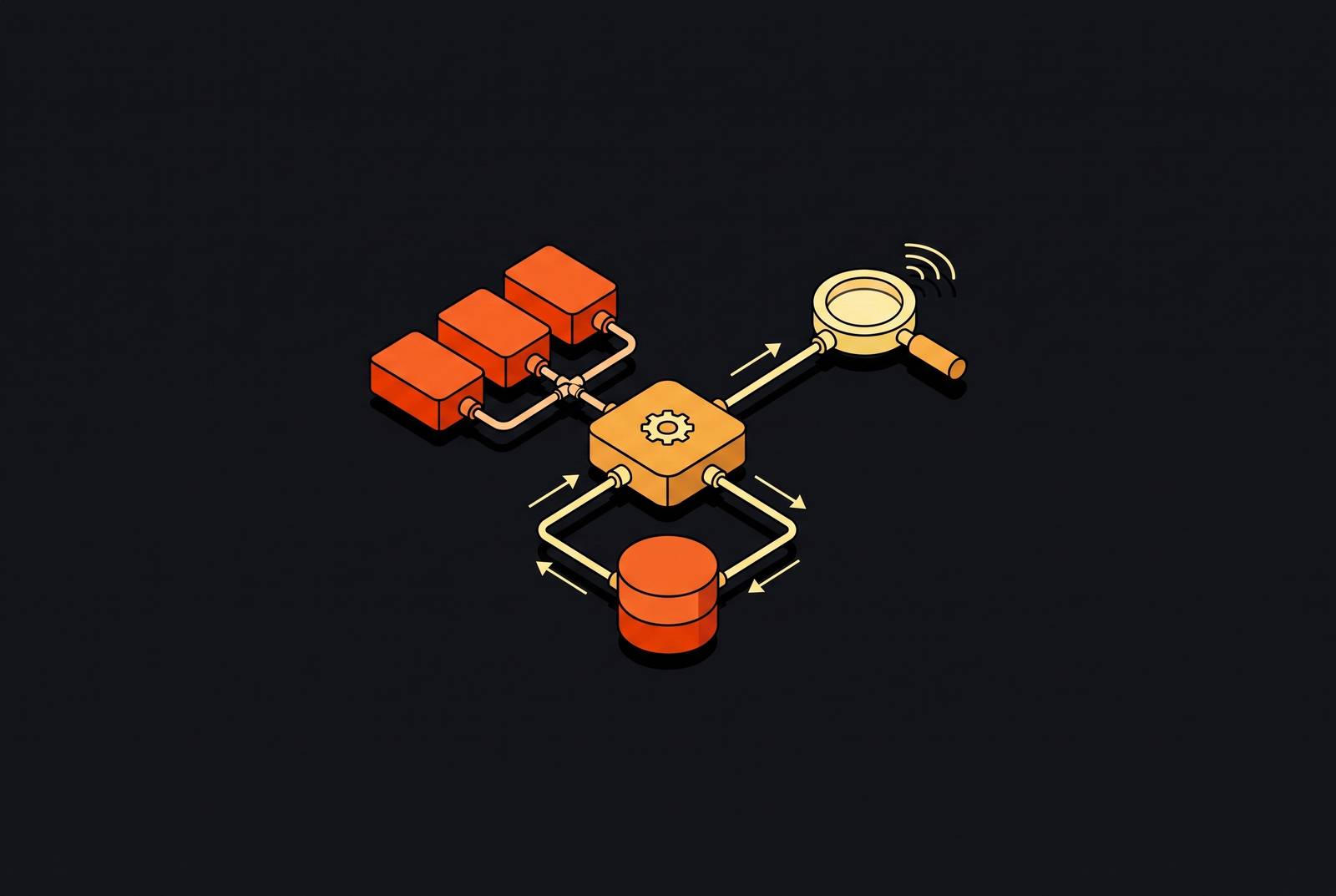
The core problem is not model quality but retrieval architecture. Small teams building agentic systems quickly discover that hallucinations are an engineering gap, not a model defect. The fix, connecting the agent to real-time web data, demands a search API layer most small teams have never priced or scoped.
That distinction carries weight. Standard RAG over pre-indexed documents suffers from indexing latency and cannot answer questions about events that occurred minutes ago. Live web grounding is the only approach that is both current and citable at answer time. Training data is fixed in model weights, and fine-tuning is only as fresh as the last run. The infrastructure question is therefore not whether to ground but which search API to route to, at what cost, and with which orchestration layer wrapping it. For many teams this is the first time the problem has been named so directly.
What the six-layer agentic stack actually costs a small team to build or rent
The six production layers that agents require are compute and sandboxing, memory, tools and actions, model routing, orchestration, and observability. Vendasta's 2026 infrastructure guide characterizes a from-scratch build as a multi-quarter commitment that becomes a permanent maintenance line. That maintenance line turns engineering bandwidth away from differentiated product work.
Each layer carries hidden costs that DIY teams chronically underestimate. Compute and sandboxing add cold-start latency and regional residency requirements beyond raw compute cost. Memory needs per-tenant isolation and embedding cost at scale, but both are easy to miss in early prototypes. Model routing demands evaluation harnesses and jailbreak resistance as ongoing costs, not one-time setup.
The search layer sits inside tools and actions, where per-query pricing compounds fastest. Rate limits, idempotency, and version drift across third-party APIs accumulate quietly. Orchestration needs state recovery after crash and human-in-the-loop mechanisms, both of which take sustained engineering attention. Observability brings PII scrubbing, jurisdictional logging, and accuracy regression alerts, all compliance costs rather than optional features. For small teams the practical framing is to embed what can be embedded and own only the layers that are genuinely differentiating. The search retrieval layer is almost never the right place to build from scratch.
What a search API must actually do inside an agentic workflow
A search API built for agentic workflows must meet requirements that consumer search engines and even many developer-oriented tools were not designed for. Mismatching tool to task is the most common reason small teams overspend or underperform on retrieval. The requirements are not exotic, but they are specific: the API must return results that are current enough to be acted upon, structured enough to feed into reasoning, and fast enough to be called inside an inner loop.
One architectural pattern makes this concrete: verification loops. A multi-step agent cross-references a claim against a fresh search before acting on it in the next step. That means the search API is called repeatedly within a single workflow, not just at entry and exit points. The API must be fast and cheap enough to sustain those repeated calls or the verification pattern collapses into a budget problem.
Before comparing specific tools, teams should understand the category split. Developer-focused search APIs, crawling and data extraction tools, research and knowledge tools, and enterprise search platforms each solve a different problem. Most small teams start with a developer-focused search API and add crawling or research depth as use cases mature. Starting in the wrong category is the single most expensive mistake available.
How search API accuracy varies across task types, and why benchmarks are the only honest comparator
Accuracy variance across search APIs is large enough to matter for small teams. But benchmark scores are only meaningful when matched to the task type the agent actually performs. Multi-hop retrieval and single-query lookup are near-orthogonal signals. Optimizing for the wrong one wastes budget in both directions: a team building a research agent that chains facts across multiple pages needs a different tool than a team building a lookup agent that retrieves a single current price or policy. Buying the highest BrowseComp score for a lookup use case is overspending.
The benchmark landscape rewards close reading. You.com's Research API self-reports a top result on DeepSearchQA, currently a high accuracy score on its Frontier tier, though independent leaderboards as of late 2026 place other models above it. Its Finance Research API ranks first on FinSearchComp's T2 sub-tier, the Simple Historical Lookup category. Both results are published publicly, which is the right standard. Benchmark claims without public methodology are marketing, not measurement.
The strongest objection to benchmark-based selection deserves acknowledgment: benchmarks are not portable across real production queries. A score on a curated test set may not predict performance on the messy, domain-specific queries a small team's agent actually generates. The answer is to treat benchmarks as a shortlist filter, then run evals on representative queries from the actual use case before committing. That two-stage approach converts benchmark data from a decision into a screening tool.
The search API options worth evaluating for agentic use cases in 2026
The developer-focused search APIs most relevant to small agentic teams differ on retrieval depth, output structure, latency profile, and pricing model. The right choice depends on which of those dimensions the team's use case weights most heavily. You.com's API suite warrants first-class consideration. It spans five APIs: Web Search, Answer, Contents, Research, and Finance Research, all purpose-built for AI systems, agents, and LLMs. The Research API holds the top position on DeepSearchQA, and the Finance Research API ranks first on FinSearchComp. The suite is built for 1659ms p99 latency alongside industry-leading accuracy, so speed and accuracy are not competing requirements. Zero data retention and SOC2 certification come included at production scale, not as premium add-ons. Enterprise clients include DuckDuckGo, Amazon, Harvey, and Windsurf. The Finance Research API returns source-reconciled, cited outputs, which matters for any agent operating in financial or compliance-sensitive workflows.
For financial data specifically, FinancialDatasets.ai offers real-time and historical financial data, SEC filings, and financial statements for tens of thousands of tickers over 30-plus years through one REST API. Its benchmark methodology samples companies across sectors, and data points are verified per audit cycle against original SEC filings or earnings releases. That audit-cycle verification is a meaningful signal for teams building agents that answer financial questions.
Crawling and data extraction tools are a distinct category from search APIs. They are useful when an agent needs structured data from a specific page rather than a ranked list of results. Product data, documentation, pricing pages, and market data at scale all fall into this category. A team that confuses a crawler with a search API will build the wrong retrieval layer and then spend a quarter unwinding it.
Which orchestration framework to pair with a search API, given real constraints on team size and complexity
The orchestration framework determines how a search API gets called, retried, and composed into multi-step reasoning. The right choice for a small team is the one that minimizes state-management engineering, not the one with the longest feature list. Each framework in the current landscape serves a specific constraint profile.
LangGraph fits workflows with branching logic, stateful execution, and human-in-the-loop checkpoints. It models the agent as a directed cyclic graph where edges are conditional transitions, with built-in persistence and rollback. LangGraph Studio provides visual debugging, and LangSmith handles tracing. MCP support runs through an adapter. Research agents, compliance pipelines, and support bots with escalation paths are the natural fits.
For teams that need multi-agent coordination with minimal boilerplate, CrewAI is the fastest path. It suits cases where multiple specialized agents must collaborate without the overhead of a full graph model. BabyAGI remains the smallest viable framework for early prototyping. Given an objective, it generates subtasks, executes them, reprioritizes based on results, and loops. No Kubernetes cluster is required, and it serves as the right prototype vehicle before committing to a heavier stack.
Microsoft Agent Framework, the successor to AutoGen and Semantic Kernel, reached 1.0 GA on April 3, 2026, in Q2 2026. It is the pick for cloud-heavy organizations that need compliance features including task adherence, PII detection, and prompt shields. AutoGen itself is in maintenance mode, so new projects should target the Agent Framework.
MCP, the Model Context Protocol, is becoming the standard connector between frameworks and external tools including search APIs. Frameworks with native MCP support avoid custom glue code for every service integration, a meaningful engineering cost reduction for small teams. Cost governance lives at this layer too: routing decisions, which model, which API, which path, are where per-query spend is actually controlled. Cost-based routing and spend tracking are dominant concerns in small-team agentic builds, and the active development in tools like LiteLLM reflects that.
How to manage data privacy and compliance requirements without treating them as a late-stage problem
Data privacy and model hallucinations are risks you face across the agentic AI stack. Leading frameworks such as OWASP's Top 10 for Agentic Applications rank goal hijack, tool misuse, and privilege abuse as the top concerns. If you treat compliance as a post-launch concern, you end up renegotiating vendor contracts or re-architecting pipelines under pressure. The regulatory environment as of 2026 makes deferral untenable.
The EU AI Act, not fully implemented until 2028, with high-risk AI obligations delayed to December 2027, classifies financial services AI as high-risk and imposes requirements for transparency, human oversight, and bias mitigation. Non-compliance with the EU AI Act and GDPR carries significant financial penalties. Compliance is not a large-enterprise concern only. It applies to any team with EU users. That single fact reorders the evaluation criteria for a search API vendor.
The practical compliance checklist for evaluating a search API vendor includes SOC 2 Type 2 certification, zero data retention options, HIPAA-ready offerings, GDPR compliance, and SSO/SAML support. You.com provides zero data retention and SOC2 certification at production scale as enterprise-tier features, available via custom Enterprise contracts rather than as out-of-the-box baseline features on standard pay-as-you-go plans. That arrangement removes a common renegotiation step for small teams reaching enterprise customers.
A separate concern comes from Cisco's 2026 Data and Privacy Benchmark Study, which found that most organizations acknowledge risk exposure from proprietary or customer data used in AI training, yet only roughly half require clear contractual terms outlining data ownership and usage. Vendor contracts need explicit review, not assumed protection. The most powerful external APIs introduce a capability versus confidentiality tradeoff when sensitive data must leave the team's environment. SLMs are becoming competitive enough that on-premise deployment is emerging as a viable path to eliminating external data-sharing risk at source. It is a trend worth monitoring, but not yet the default recommendation for most small teams.
A cost-governance pattern for keeping search API spend predictable as agent usage grows
Search API costs compound in ways that early prototypes do not reveal. Agents make multiple search calls per task, and usage grows non-linearly as workflows get more capable. Teams that do not instrument spend from the start face surprise invoices as soon as the agent goes beyond toy usage. The pattern for governance is straightforward but requires discipline at the orchestration layer.
The first principle is to route queries by task type. Multi-hop research queries that require deep retrieval should go to a research-grade API. Single-fact lookups can route to a lighter, lower-cost endpoint. Mixing these up in either direction wastes money: expensive deep retrieval on trivial lookups, or shallow retrieval on queries that demand multi-page synthesis.
The second principle is to instrument per-call spend at the orchestration layer, not just at billing reconciliation time. Cost-based routing in LiteLLM and similar tools allows spend caps per workflow, not just per month. That granularity is what makes budgets enforceable. Verification-loop budgets follow naturally: if the agent cross-checks facts against fresh search at each reasoning step, define which steps require verification and which can proceed on cached context. Unbounded verification loops are accurate but expensive. Structured output cuts cost too, because APIs that return clean, predictable fields reduce downstream processing and the need for follow-up calls to clean or re-fetch results.
The model cost floor is compressing. New entrants in the LLM market have driven per-token costs down, which changes the relative weight of search API cost in the total workflow budget. But search API quality differences remain significant enough that the cheapest option is not automatically the right choice. Cost governance means controlling spend without surrendering the retrieval quality that makes grounding work.
When to scale the search infrastructure and what signals to watch for
The right search infrastructure for a small team today will not be the right infrastructure at scale. Teams that wait for obvious failure signals before re-evaluating vendor and architecture choices absorb more disruption than teams that track leading indicators from day one. The signals are observable early if a team knows where to look.
Latency degradation at the workflow level is the first indicator, not just per-call latency but aggregate time-to-answer as agent complexity grows. Accuracy regressions on specific query types that the current provider does not handle well surface through eval pipelines, not user complaints. Compliance requirements hardening is a third signal: a customer asking for SOC 2 certification or a data processing agreement forces a vendor conversation that is easier before production lock-in. Cost-per-workflow crossing a threshold that makes the unit economics of the agent-powered feature unviable is the final and most direct signal.
Stage III of agentic AI development, spanning 2026 to 2029, is when specialized agents coordinate as teams. The single-agent search integration you build today will need to support multi-agent patterns sooner than you expect. Choosing an API with enterprise-grade throughput and reliability now avoids a disruptive swap later. The practical scaling path ties the whole chain together: prototype with the lightest orchestration framework that handles the use case, whether BabyAGI or CrewAI. Validate retrieval quality with benchmark-filtered evals on real queries. Lock in a search API that satisfies compliance requirements and publishes its performance results publicly. Then graduate to a more capable orchestration layer, LangGraph or Microsoft Agent Framework, as workflow complexity warrants.