Real-Time Web Data Providers for LLM Knowledge Cutoff Problems
Retrieval layers now separate production systems from hallucinations about current events.

A developer asks a model about a product released last month. The model answers confidently, describing an earlier version as though it were current, or inventing a plausible-sounding feature set that does not exist. It is what happens whenever a transformer-based LLM is asked about anything past the date its training data stopped: the weights encode everything learned up to a fixed point, and nothing after that point exists in the model's world unless it gets injected at inference time. Training a large language model takes immense compute and runs for weeks or months, so continuous retraining is not something any lab can do on a rolling basis. Cutoffs are a permanent feature of how these systems get built, not a bug waiting for a patch. The dangerous part is that the model does not know what it does not know, so it will answer a post-cutoff question with the same confidence it brings to anything else, and the result reads as hallucination when it is actually a structural limit doing what it was always going to do. The correct bug report for a wrong answer about current events is "the system was not designed to supply current information," and that framing tells an engineering team whether to reach for a bigger model or for a retrieval layer.
The Cutoff Gap in Today's Models
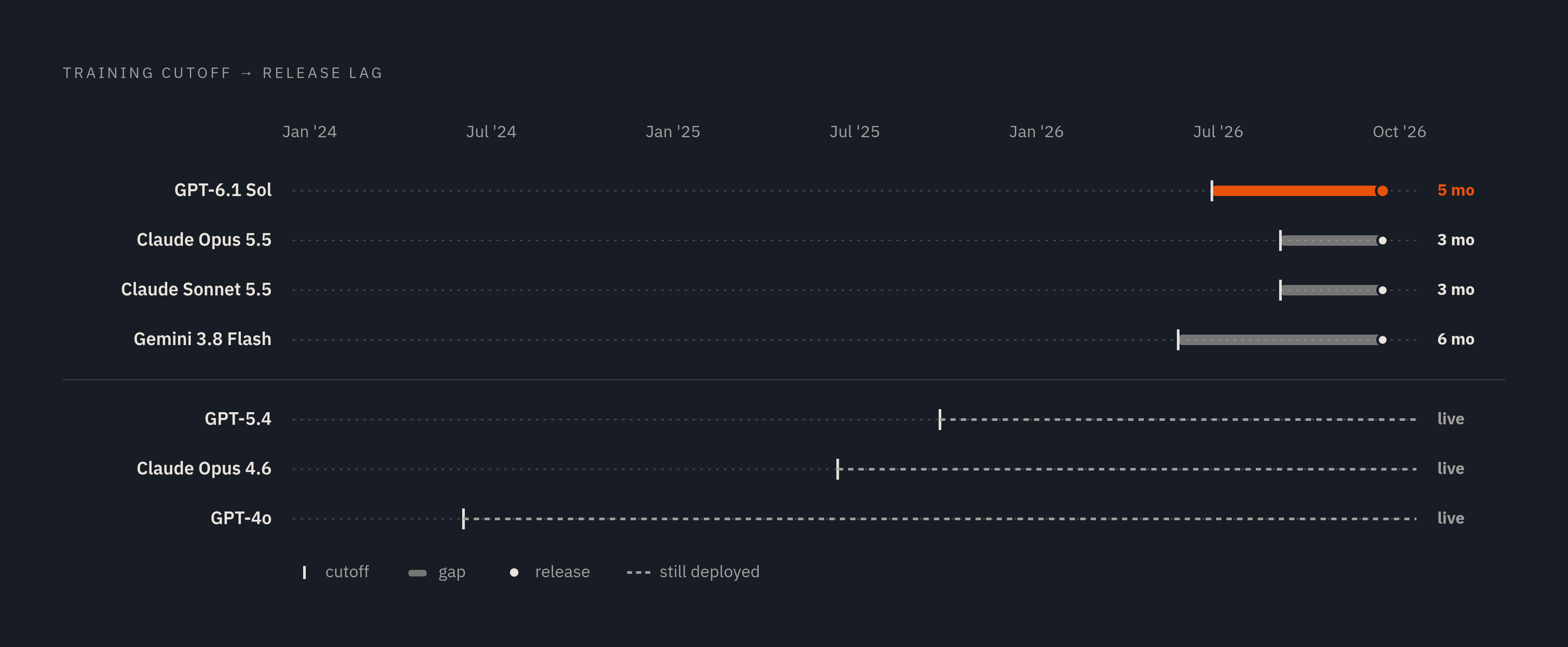
The scale of this gap is easy to underestimate because release dates and cutoff dates get conflated, and the lag between them stretches further than most builders assume. OpenAI's GPT-6.1 Sol carries an April 30, 2026 cutoff against a September 29, 2026 release, a five-month gap before the model even reaches a developer's hands. GPT-5.4, still a workhorse in production systems, has an August 31, 2025 cutoff, and GPT-4o, which remains live in APIs builders are actively calling today, carries a June 2024 cutoff. Anthropic's newest pair, Claude Sonnet 5.5 and Claude Opus 5.5, both hold a June 2026 cutoff, with Opus 5.5 released September 22, 2026 and Sonnet 5.5 six days later. Claude Opus 4.6, still present in plenty of deployed systems, carries a May 2025 reliable cutoff, a figure Anthropic itself distinguishes from the broader training data cutoff, showing that even the model maker treats "cutoff" as a range of dates. Google's Gemini 3.8 Flash, released September 2, 2026, reports a March 2026 cutoff, yet Google states that knowledge in some domains remains limited to January 2025. A single cutoff date, in other words, is a simplification that overstates how fresh the model actually is on any given topic. The pattern holds across every major family in active use: months to more than a year of lag, compounding with release delays, at every price tier and every vendor. No model family currently on the market earns the label "fresh enough" to skip retrieval.
Real-Time Web Retrieval as the Reliable Fix
Grounding a model's output in live web data is the one mechanism that addresses the cutoff problem without retraining anything, which makes retrieval an unavoidable layer in any production system that has to answer questions about the present. The pattern has gone through real stages of maturity. Early retrieval-augmented generation pulled from a static database using keyword matching, semantic vector search improved relevance by matching meaning rather than exact terms, and the current frontier is browsing agents that read live pages and follow links in real time, with each stage closing more of the gap between what a model knows and what is actually true today. One might argue that this problem is already solved: Gemini offers Google Search grounding, Grok searches X and the web natively, so why build anything? That's a fair point for the consumer products themselves, where the search layer is baked into the experience a user gets when they open the app. But it does not follow that the underlying model API hands that same capability to a developer by default. Claude requires an explicit tool declaration, a tools array entry in the API request, before it can touch retrieval. GPT models called through the Responses API need a tool-use layer that the developer wires themselves, though the Chat Completions search-native models, gpt-5-search-api among them, do search automatically without that extra configuration. Native retrieval at the product layer and retrieval infrastructure available to an API builder are two different things, and conflating them is how teams end up shipping agents that silently fall back to stale parametric memory. For local and open-weight deployments, there is no retrieval layer sitting underneath by default. For those builders, a RAG pipeline connected to a live web data source is the only path to current information.
What Separates a Capable Web Data Provider from a SERP Wrapper
Once retrieval is accepted as architecturally necessary, the next question is which retrieval. Not all web data APIs do the same job, and the distance between a raw search wrapper that returns a page of blue links and a research-grade API that returns cited, synthesized content is the distance between a shortcut and actual infrastructure. A few dimensions decide which side of that line a provider falls on.
Freshness is the first test, and the operative question is not whether a provider claims a live index but how quickly new content actually becomes queryable after it appears on the web. A provider whose index lags by days defeats the purpose of retrieval just as surely as a stale model does.
Content depth matters nearly as much. A provider that returns a list of URLs and snippets has handed the synthesis work back to the LLM, which then has to make a second round of calls just to fetch and read the pages it was pointed at. A provider that returns full extracted page content up front cuts that extra round-trip out of the pipeline, which lowers both latency and the number of inference steps an agent needs to complete a task.
Citation grounding is non-negotiable for research, finance, legal, or compliance use cases. An answer that gets synthesized without a traceable source is an answer nobody downstream can verify or audit, which is a serious liability the moment the use case touches anything regulated.
Accuracy is measurable, so builders should treat self-reported capability claims with real skepticism and ask for benchmark evidence instead. And latency compounds in agentic workflows: a single agent might fire off dozens of retrieval calls across one task, so a provider with a slow p99 introduces a bottleneck that multiplies across every step downstream. Speed and accuracy are both table stakes here, not a tradeoff a builder gets to pick one side of.
The real-time web data providers builders are choosing between
The market has split into categories that look similar from a distance but serve different jobs: answer engines with search bundled in, model-native retrieval tied to a specific consumer product, enterprise research services, and purpose-built web data APIs meant for agents. Picking among them starts with asking what the system actually needs, raw results, extracted content, or synthesized research with citations attached.
You.com occupies the purpose-built end of that spectrum with a Web Search API, Contents API, Research API, and Finance Research API aimed squarely at AI systems and agents. The Research API held the top position on the DeepSearchQA benchmark at launch, a position it no longer holds, which is itself a useful reminder that this space moves fast enough that yesterday's leaderboard is not a permanent claim. The Finance Research API currently ranks first on FinSearchComp's T2 Simple Historical Lookup sub-task, a result that is publicly checkable. The Contents API returns full extracted page content rather than snippets, which trims the extra fetch-and-read cycle out of an agentic pipeline. Enterprise clients include DuckDuckGo, Bank of America, and Amazon, and the platform carries SOC 2 Type 2 certification with zero data retention available on Enterprise plans, details that matter to any team operating under compliance review. The Finance Research API specifically delivers source-reconciled, cited output built for regulated financial workflows, where an answer nobody can trace back to a source is not an acceptable answer.
Perplexity Sonar takes a different shape: most Sonar models integrate real-time web search directly, letting them answer past their training cutoff without a separate retrieval step bolted on. It functions as an answer engine with search built in, which suits conversational search applications well but offers less to a builder who wants raw content extraction or a custom retrieval pipeline they control end to end.
Linkup runs as a production web search and research API with a /research endpoint that performs multi-step web investigation, synthesizes what it finds, and returns structured, cited output. It is used in enterprise deployments at McKinsey, KPMG, and Cohere, and it positions itself as a deep research API rather than a high-throughput search layer meant for firing thousands of quick queries.
Coresignal's Agentic Search API serves a narrower, more specific job: structured B2B intelligence rather than open-web crawling, accepting natural language queries and returning verified records across company, employee, and job posting data. That makes it purpose-built for lead enrichment and competitive intelligence work, not general web retrieval for an agent that needs to answer arbitrary current-events questions.
The model-native options, Grok's combined X-and-web search and Gemini's built-in Google Search grounding, matter as context even though they are not infrastructure a builder can plug into a model-agnostic agent. Their existence confirms that even the labs building these models have concluded retrieval is necessary. That is a meaningful signal about where the industry has landed, even if it does not hand an API builder anything to build with directly.
The accuracy gap benchmarks expose behind provider marketing
Retrieval accuracy can be measured. Choosing a provider without looking at benchmark evidence means making an infrastructure decision on faith. That risk does not stay contained to one bad answer. It compounds across every single call an agent makes once that provider is wired into production. Self-reported capability claims, including the cutoff dates models report about themselves, have proven unreliable enough that third-party evaluation is the only comparison worth trusting.
The tooling for this kind of evaluation is catching up to the need. Vals AI has published a Web Search Index that compares native provider search across Finance Agent Benchmark and Legal Research Benchmark tasks, measuring accuracy by model and search-tool combination.
Accuracy alone does not tell the whole story, either. Citation grounding, whether the sources a system cites actually support the claim attached to them, matters just as much, alongside consistency across repeated queries, correct abstention when the system lacks reliable information, and latency under real load. You.com's Research API holding the top spot on DeepSearchQA at launch and its Finance Research API ranking first on FinSearchComp's T2 sub-task are the kind of domain-specific, independently checkable results that should set the bar for what evidence looks like before any provider gets taken seriously.
One might object that benchmarks can be gamed, and that objection has some truth to it. But that is an argument for consulting multiple independent benchmarks and running domain-specific evaluations against the builder's own query distribution, not an argument for throwing benchmarks out and trusting a vendor's word instead. Treat a strong benchmark result as the entrance requirement for a shortlist, then test latency and integration against the actual workload the system will run.
The right retrieval architecture for production agentic systems
Wiring retrieval into a production agent is an architectural pattern that shapes how current, accurate, and auditable every output from that agent will be, across every task it ever runs. The basic shape of it: the agent recognizes that a query may touch post-cutoff information, routes that query to a web data API, receives back extracted and, ideally, pre-synthesized content with citations attached, and injects that content into the model's context window before generation happens. The model is then reasoning over material it was never trained on, grounded in sources that can be checked rather than parametric memory that can only be trusted.
That compounding effect from the benchmarks section applies here too. A competitive research agent might make dozens of retrieval calls across a single task, and a provider's latency at p99 is the figure that decides whether the whole pipeline holds up. One slow call in the tail delays every step that comes after it, and in a multi-step agent that delay does not stay isolated to one task; it propagates.
For finance, legal, compliance, and audit work, the retrieval layer has to return citations the system can surface to a user or log for later review. An agent that synthesizes an answer without citing where it came from produces output nobody can verify after the fact, which is a structural compliance risk long before anyone gets to argue about whether the answer was even correct. Source-reconciled, cited output solves that problem at the infrastructure layer, before the model ever generates a response, which is a meaningfully different guarantee than trying to catch unsupported claims after generation has already happened. That is the actual shape of the decision in front of builders: not whether to add retrieval, since the cutoff gap settles that question on its own, but which retrieval infrastructure earns the trust an agent's output will be asked to carry.