Structured Data Extraction From Web Pages for RAG Grounding
A four-stage pipeline ensures RAG data stays grounded instead of fabricated.
Structured data extraction for RAG grounding has its own output contract, built around a four-stage pipeline (fetch, extract, convert, chunk) where each stage either preserves retrieval accuracy or introduces errors that make an LLM's answer fabricated rather than grounded. This piece walks through why that distinction exists, how the pipeline operationalizes it, where build-vs-buy decisions fall, and where the hardest cases (tabular data, live information, financial filings, and now GDPR compliance) stretch the discipline to its limits.
RAG scraping as a discipline distinct from classic web scraping
Classic web scraping has a clear, narrow job. A script visits a page, finds a price or a title or a listing, and exports it as a row in a JSON file or a CSV. The target is a field. If that field was captured correctly, you're done, and nothing else about the page matters much.
RAG scraping starts from a different premise. The RAG scraping literature makes this distinction explicit: the deliverable is not raw HTML and not a single extracted field, but a grounded, well-structured passage, because retrieval accuracy and answer quality depend on what that passage actually contains, not merely on whether some data was captured.
That difference in target produces a difference in failure mode. When raw HTML lands in a RAG pipeline unfiltered, it hurts the system in three distinct ways. Navigation menus, ad units, embedded scripts, and repeated boilerplate all eat up token budget that could instead hold actual content. At query time, the wrong passages get retrieved, and the model builds its answer out of material that was never meant to answer anything.
Treating RAG scraping as a variant of classic field-scraping, rather than as its own discipline with its own quality standard, is the forcing function behind this entire discipline, and is how pipelines end up technically functional and practically useless.
The four-stage pipeline as a quality gate at each stage
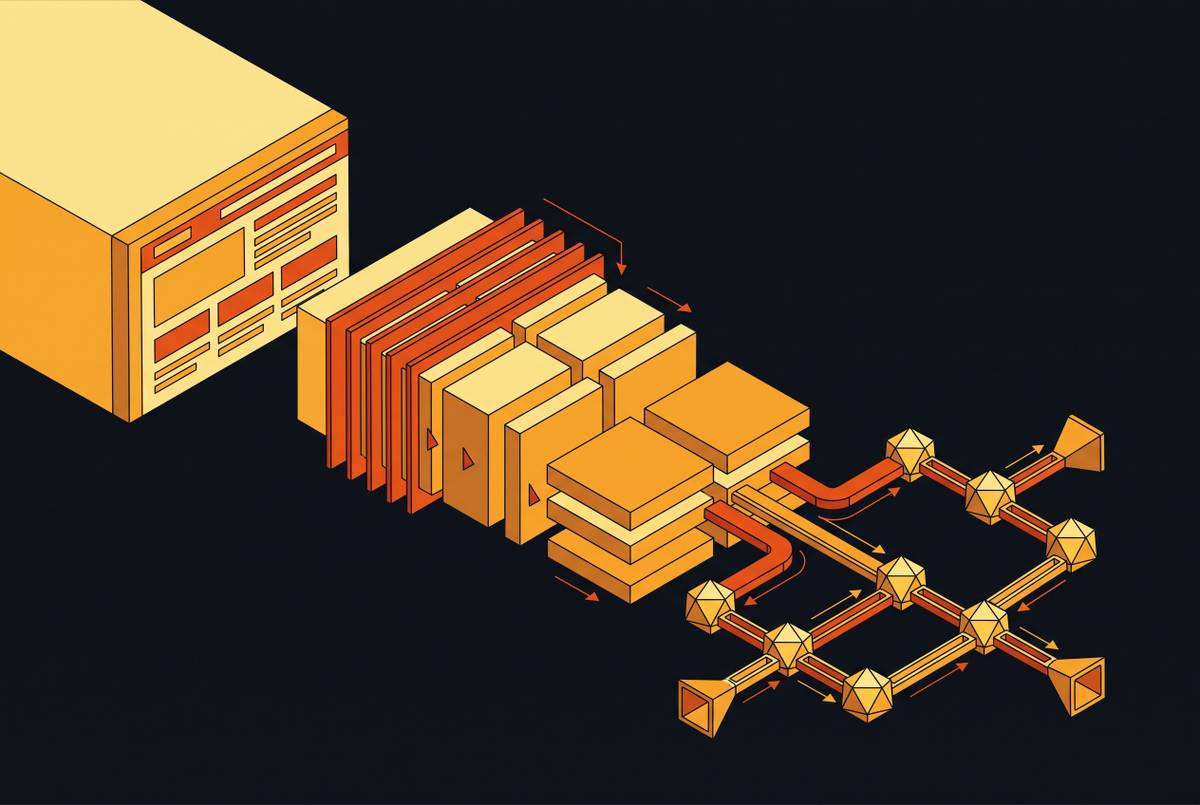
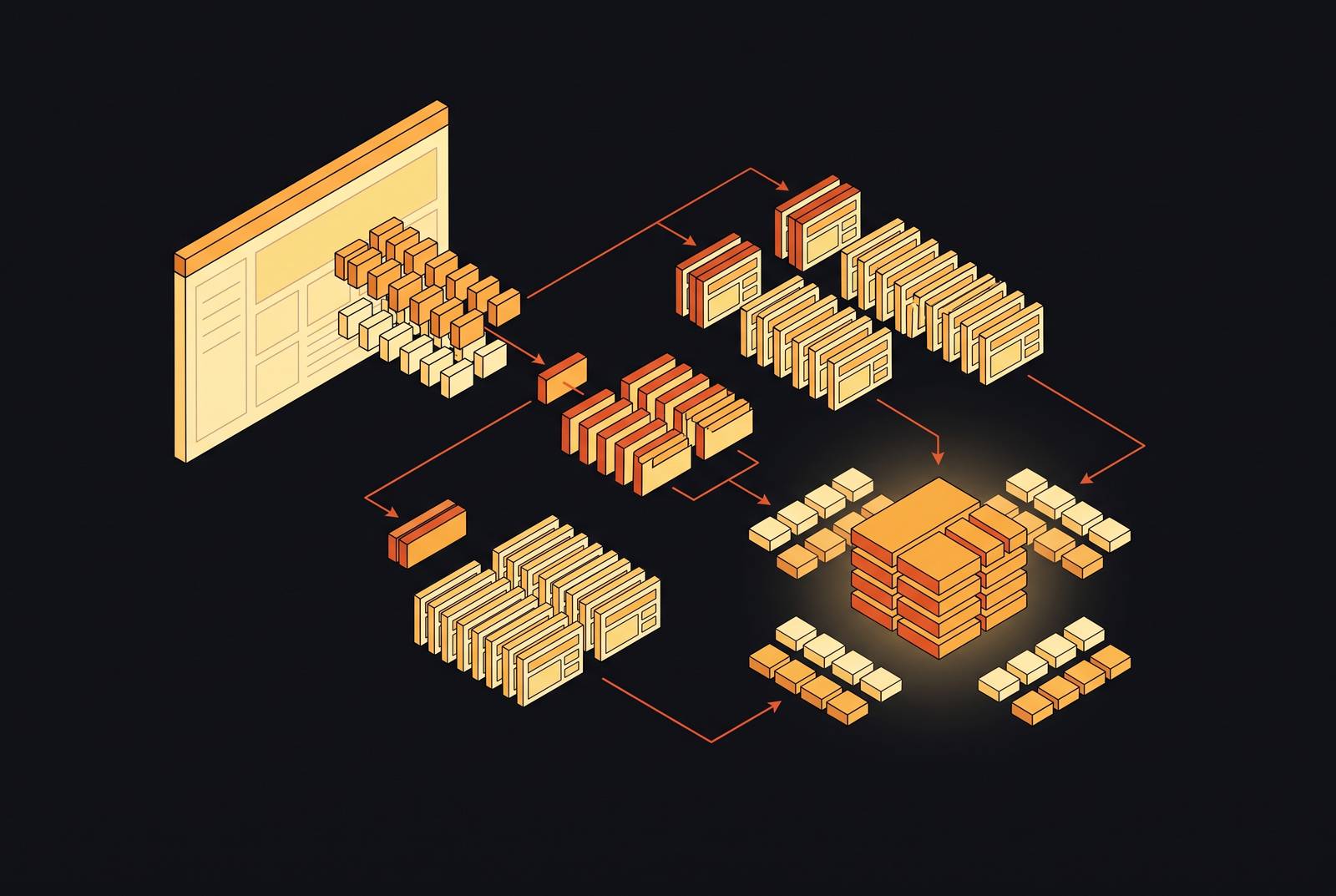
The operational answer to that problem is a four-stage pipeline: fetch, extract, convert, chunk. Each stage is a checkpoint, so you either keep the quality there or you lose it, and if something fails early on, later stages cannot fully repair it. However well you tune a chunking strategy, it cannot recover information that extraction discarded. If a fetch only caught half a page's content because the JavaScript hadn't finished rendering, a clean conversion to Markdown can't fix that.
Fetching is the first gate. Static pages are straightforward, answerable with a simple HTTP request. None of this is exotic engineering, but it is a known operational burden, not a detail to wave past.
Extraction is where the two disciplines genuinely part ways. Classic scraping extracts a field and moves on. RAG scraping has to identify the meaningful body content of a page and discard everything else: navigation menus, footers, cookie banners, ad units. The RAG scraping literature treats this as the central quality decision in the whole pipeline, because boilerplate that survives extraction does not just sit there harmlessly. It bloats the index and returns irrelevant chunks at retrieval time, so you get the same failure raw HTML produces, just reintroduced one stage later by a filter that wasn't strict enough.
Conversion turns that extracted content into clean text or, preferably, Markdown. Conversion fidelity determines retrieval accuracy. Tools built specifically for RAG pipelines aim at token-efficient Markdown output for exactly this reason: they strip scripts, styling, ads, and navigation, and output only the factual content, because token overhead at this stage multiplies across every single query the index will ever serve.
Chunking closes the pipeline, and it can fail in both directions. The pattern that has emerged as standard practice is explicit: convert to Markdown first, chunk by headings against a token ceiling, then embed. That order suits most structured-document pipelines, but newer strategies such as late chunking invert the chunk-then-embed sequence, so even this stage is still being refined, not settled.
This four-stage logic holds regardless of who performs each stage. A team can build and operate all four stages itself, or it can delegate some of them to infrastructure built for the purpose. That choice, and where the line is best drawn, is the subject of the next section.
Build-vs-buy decisions at each pipeline stage
Custom scripts are a reasonable answer to a narrow problem. If you need a one-off, low-volume pull from a handful of simple static pages, a hand-written scraper does the job without much fuss. Production RAG pipelines ask for something categorically different: rendering at scale, anti-bot handling that survives a target site changing its defenses, batching across thousands of pages, and structured output a downstream system can rely on consistently. Brittle custom scrapers tend to degrade under exactly that load because production conditions are far more varied than the conditions the script was written against.
Getting a page's data once is a solved problem. Maintaining reliability, scale, and compliance under continuous production use is a different order of difficulty, and that is where most of the real operational cost in a RAG pipeline sits. Managing headless browsers at scale, rotating proxy networks to avoid blocks, validating schema on every batch, and deduplicating overlapping content all have to happen before any data reaches the embedding step, and each of those tasks carries its own maintenance burden over time.
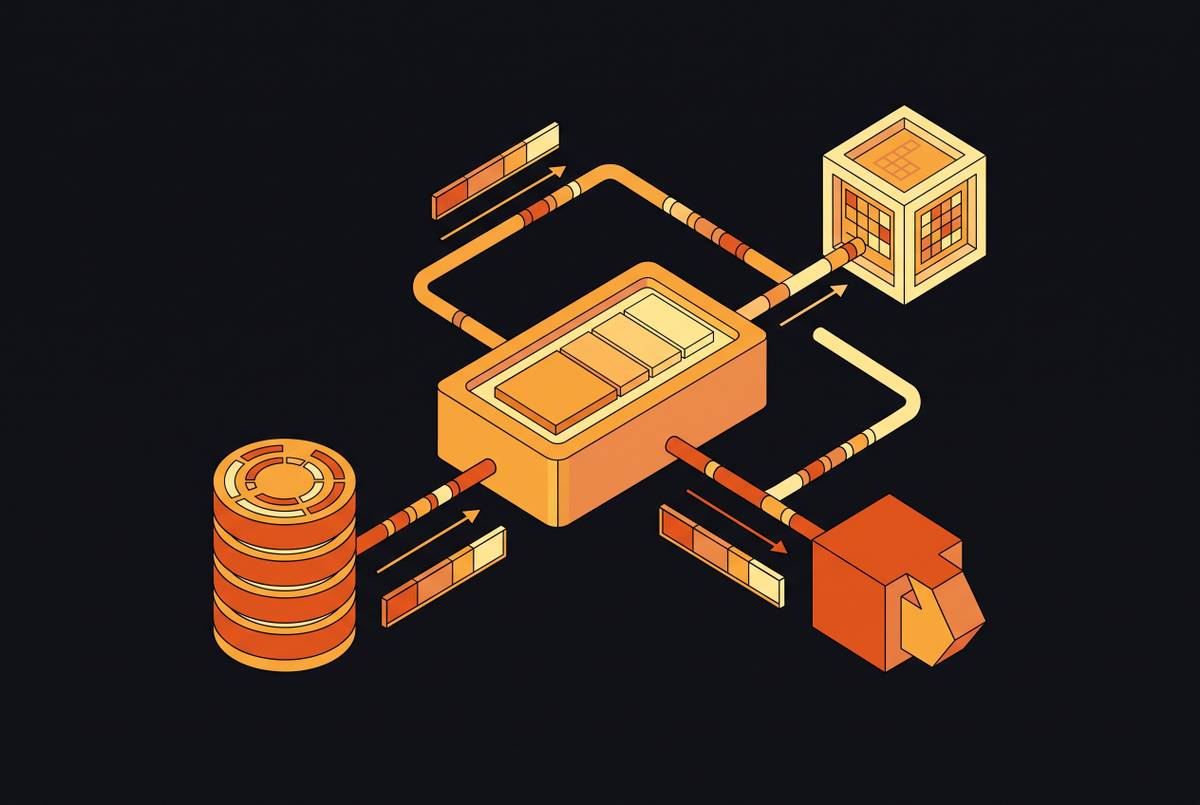
Three architectures exist for connecting external information to an LLM pipeline, and the choice between them has real latency and richness trade-offs. A tool-use architecture lets the LLM call a search tool mid-generation, when its own reasoning tells it that it needs outside evidence. That approach is more dynamic and better matched to open-ended queries, at the cost of higher latency per call. (A third, agentic pattern, where the system fetches, reasons, and iterates across multiple steps, is covered in more depth further on.)
For teams deciding how much of the fetch and extract burden to own directly, managed search infrastructure is a credible answer rather than a workaround. You.com's Web Search API and Contents API, for instance, abstract away exactly the two stages that carry the heaviest engineering cost: the caller receives clean, grounded results without having to manage rendering, proxy rotation, or bot detection internally, and that output can feed directly into a team's own convert and chunk stages. What a team actually has to decide is not whether to use infrastructure at all, since almost nobody hand-rolls headless browser orchestration at scale for fun, but which stages are worth owning because they're differentiated, and which stages it can treat as solved problems and buy off the shelf.
Structured extraction for tabular and relational data in retrieval
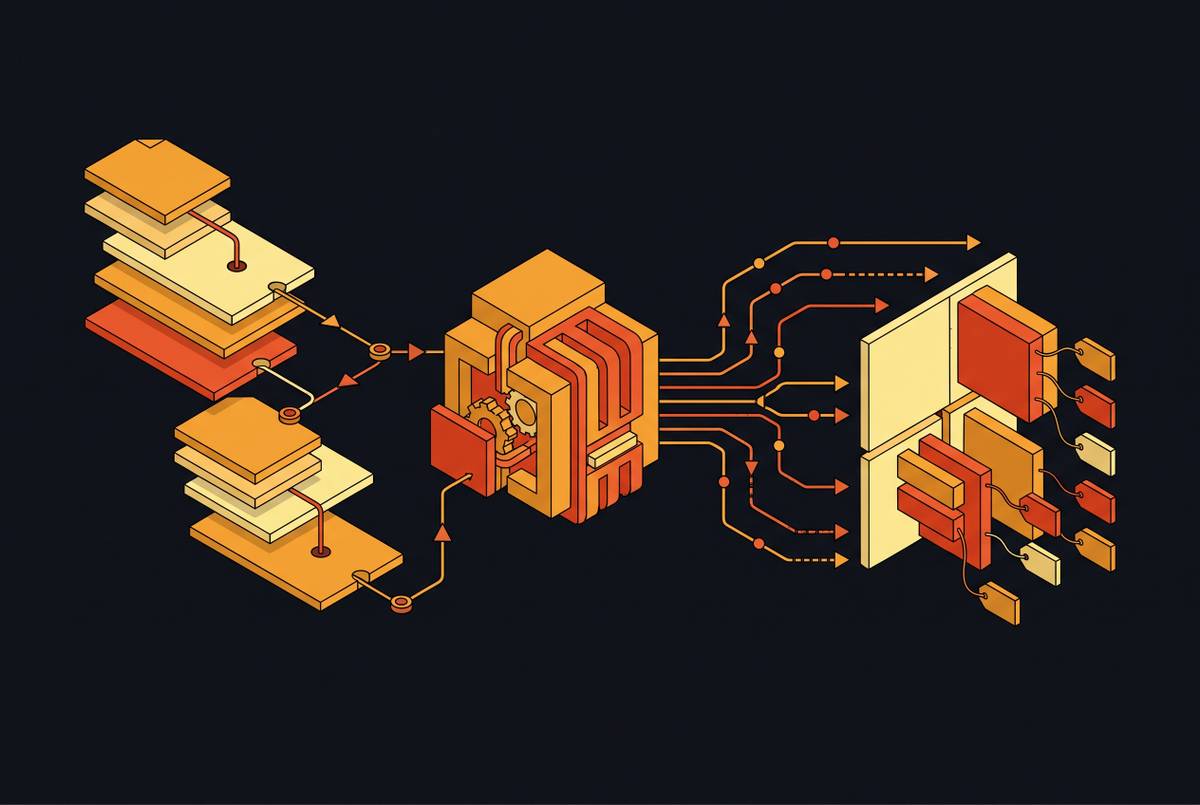
Clean prose is not the whole problem. Embedding-based retrieval is very good at surfacing passages that are semantically close to a query, but research and analytical domains frequently depend on quantitative and categorical variables, exact figures, measured quantities, classified outcomes, that narrative text was never designed to carry efficiently. Structured extraction converts unstructured content into tabular or schema-mapped data to close that specific gap, and you have to run it as its own extraction mode alongside prose chunking, not as an afterthought to it.
A RAG system built for mycorrhizal fungi research at Université Côte d'Azur illustrates the pattern concretely. The system combined semantic retrieval of domain-specific text from agronomy and biotechnology corpora with structured extraction of experimental metadata, inoculation methods, spore densities, soil parameters, yield outcomes, because neither mode alone captured the full evidence base the domain actually required. Prose retrieval surfaced the discussion, and structured extraction surfaced the numbers the discussion was discussing.
That example generalizes into a design requirement. Teams building domain-specific RAG systems have to decide, at the extract stage, whether a given piece of content belongs in prose chunking or in structured field extraction, and a corpus that mixes narrative and tabular material, as most serious technical and scientific corpora do, cannot be served adequately by a single pipeline mode applied uniformly. You have to make the decision per document, sometimes per section, rather than assume it at the architecture level.
Agentic grounding as a live alternative to pre-indexed RAG
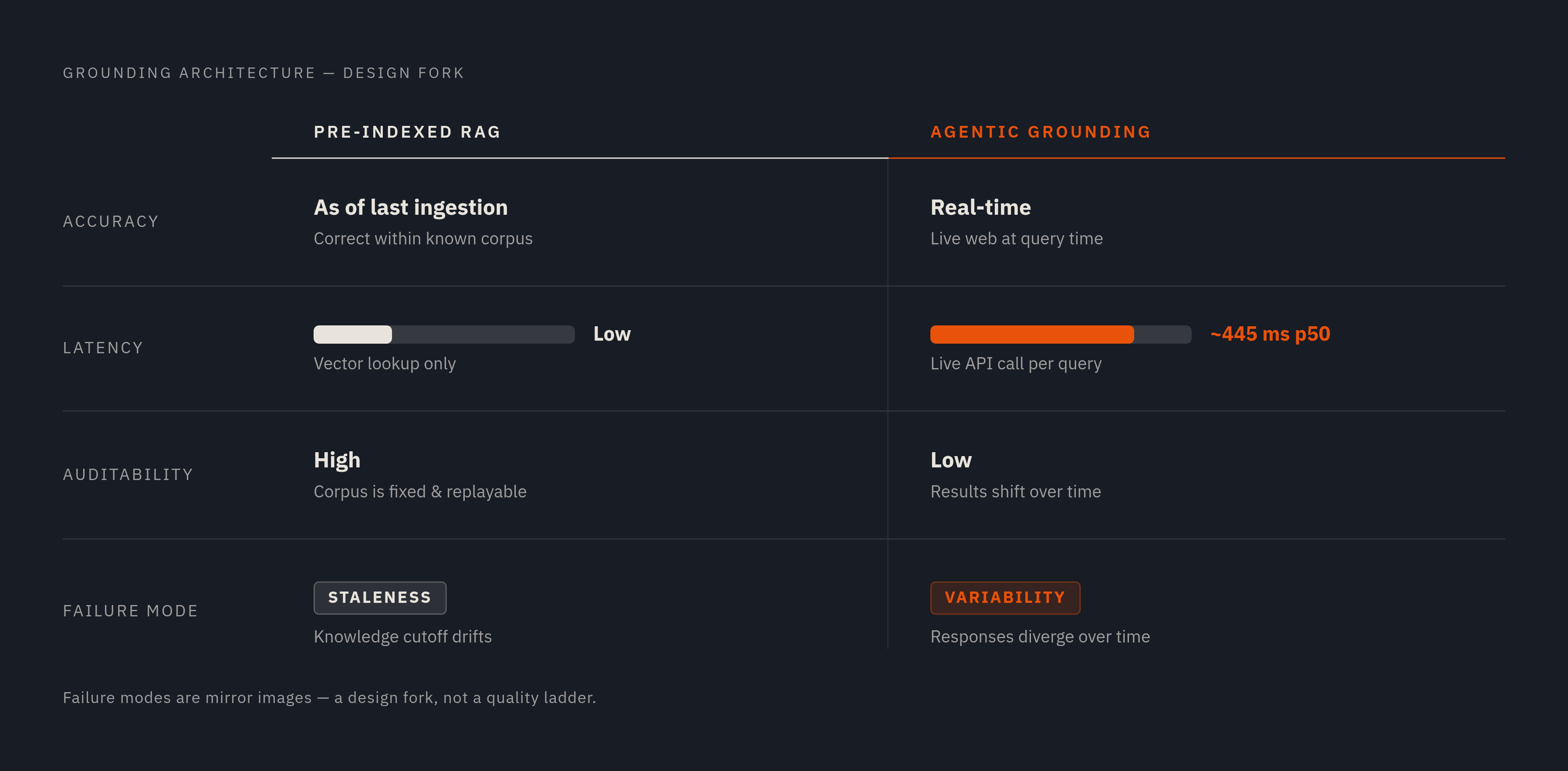
Everything described so far assumes a pre-built index: a corpus fetched, extracted, converted, and chunked ahead of time, sitting ready for a retriever to query. That assumption is not universal, and treating it as a given is itself a design decision with consequences. Pre-indexed RAG and agentic grounding represent different models of when extraction happens, not competing implementations of the same underlying idea, and each carries its own accuracy, latency, and auditability profile.
Pre-indexed RAG runs the four-stage pipeline on a schedule, builds a stable index, and retrieves from it when a query comes in. That gives answers that are accurate as of the last ingestion run, citable against known chunks, and auditable after the fact, which makes it well suited to stable private knowledge bases, internal documentation, and regulated workflows where being able to point to exactly which source produced an answer matters. Its failure mode is staleness: content can drift out of date between ingestion runs, and the system will answer confidently from an index that has silently diverged from the live web. Change tracking matters for any knowledge base built this way.
Agentic grounding skips the pre-built index. That fits fast-changing facts, competitive intelligence, and autonomous agents that cannot know ahead of time what information they will need. Its failure mode runs in the opposite direction from pre-indexed RAG's: live fetching adds latency to every query, and the retrieved set can vary from one run to the next, which makes reproducibility harder to guarantee.
Teams are splitting along fairly predictable lines. Regulated industries lean toward scheduled, pre-indexed RAG because they need auditability, not because they merely prefer it. Agent-native startups lean toward live grounding because fresher answers matter more to them than reproducing an identical answer twice. Some of the more mature pipelines do not choose one model exclusively; they combine both, so you get a pre-indexed corpus for stable background knowledge and a live fetch layer for anything time-sensitive. You.com's Web Search and Research APIs are built for that live-grounding path specifically: they run at roughly 445ms p50 latency with real-time indexed results, so an agent's fetch-extract-reason loop stays inside a single task cycle instead of letting round-trip cost dominate the workflow. You should not let a pipeline default into pre-indexed or live grounding without examining the choice first, because each path solves a different problem, and the wrong default produces a failure mode that will not show itself until something goes stale or takes too long.
Financial data as the hardest stress test for a RAG extraction pipeline
Financial document extraction exposes pipeline weaknesses more aggressively than almost any other domain, because the source material is heterogeneous (statements, covenants, regulatory filings, market data feeds), tightly regulated, and consequential in a way that a broken product description simply is not. An extraction error here does not stay cosmetic. It propagates into a downstream decision, and that decision can involve real money.
The CFA Institute's 2025 agentic AI finance guide documents one concrete pattern for how that orchestration looks in practice: a Multi-Asset Research Assistant that first classifies an incoming query as equity, credit, or macro, then routes it to a specialist agent built for that category. Every one of those downstream tools depends entirely on clean, structured extraction upstream, because a parser handed a wall of unstructured text cannot build a reliable DCF model from it.
The operational payoff of getting this right is not hypothetical. At a European bank, Accenture implemented a pipeline that classifies incoming documents, ingests and extracts KYC data points, validates the results, remediates missing data, and presents everything in a consistent format. For complex correspondent banking cases, that pipeline reduced ingestion time dramatically and raised the quality of the output, which is the clearest evidence available that pipeline discipline, the same fetch-extract-convert-chunk logic described earlier in this piece, translates directly into measurable operational outcomes rather than staying a theoretical nicety.
GDPR and the EDPB's 2026 scraping guidelines for compliant pipelines
A piece of data being publicly visible on the web does not make it freely usable for training or grounding an AI system. The EDPB's guidelines on web scraping for generative AI state that GDPR applies to scraped personal data even when that data sits in plain view on a public page. That single point reshapes how a compliant pipeline has to be built, because it means the four-stage pipeline described earlier now has a legal dimension layered across every stage, not just a technical one.
The compliance burden falls on the controller before scraping ever begins, not after data has already been collected and indexed. That timing matters enormously for pipeline design. Compliance decisions have to be embedded at the fetch and extract stages themselves, where the content first enters the system, rather than treated as a cleanup task to handle once a model has already been trained or an index already built. Retroactively scrubbing personal data out of an existing index is a far harder problem than deciding, at the point of collection, not to collect it.
The EDPB lays out concrete technical measures you have to apply before you even start collecting data. Each of those measures sits upstream of the fetch stage described earlier in this piece. The pipeline-first argument this piece has been building is, at its foundation, a compliance argument as well: a pipeline that treats data governance as a design input at stage one is in a fundamentally different position than one that discovers its legal exposure only after the index is already built.