Freshness vs. Relevance Trade-Offs in Document Retrieval
Semantic search can't tell old from new, and that gets costly.

A compliance team updates a policy in March. The vector index keeps serving the February version in September, and it does so with a similarity score high enough to look authoritative. This is the subject of this piece: why retrieval systems built on semantic search have no built-in way to tell old from new, and what that blindness costs as the stakes rise from a wrong answer in a chatbot to a regulatory violation in a financial workflow.
Why standard retrieval pipelines are architecturally blind to time
Picture a support bot that pulls up a compliance policy for a user, confident and fast, except the policy was superseded five months earlier. The retrieved document still carries a near-perfect cosine similarity score against the query. Nothing in the pipeline flagged it as wrong, because nothing in the pipeline was built to notice that time had passed. Standard retrieval systems rank candidate documents by semantic proximity alone, and proximity has no clock in it. A vector embedding encodes where a piece of text sits in meaning-space: what it's about, how its concepts relate to other concepts, which neighbors in that space share its subject matter. It does not encode when that text was true, when it was superseded, or whether anyone bothered to update it since. The retrieval layer, looking only at vector distance, has no mechanism to prefer the newer document unless something outside the embedding itself tells it to.
This gap matters more as retrieval systems get asked to ground answers in information that changes by the week rather than the year. The deeper point stands regardless of which search layer sits downstream: this isn't a defect in any particular embedding model or a sign that the system needs more tuning. The architecture was never asked to track time in the first place, and every failure mode that follows in this piece traces back to that one omission.
Three distinct root causes that compound the staleness problem
The freshness-relevance tension doesn't come from one bug with one fix. Three independent failure modes produce it through different mechanisms, and treating them as a single problem tends to produce a single, incomplete patch.
The first is source document drift: the real world changes, and the index doesn't notice. It still matches relevant queries. It still gets retrieved with confidence. The model is retrieving what it was trained to retrieve. Nobody told the index that the world moved on.
The second is embedding model drift, which happens when a team upgrades its embedding model and the geometry of the entire vector space shifts under it. Full model swaps tend to get caught, since someone usually notices that search quality collapsed overnight. The more dangerous version is partial: some documents get re-embedded with the new model while others sit indexed under the old one, producing a mixed-generation vector store where similarity scores are computed across two incompatible geometries and the system has no way to tell which vectors belong to which generation.
The third is index fragmentation from incremental updates, a subtler problem rooted in how chunking interacts with tokenization. Left unaddressed, incremental indexing also accumulates its own structural debt: the HNSW graph underlying most approximate nearest-neighbor search degrades in efficiency over repeated incremental insertions, which quietly erodes query latency even when nothing about the content itself has changed.
A single outdated document is a bug worth a ticket. A corpus where a meaningful share of the index has aged past its useful lifespan is an architectural failure, and most teams don't find out which one they have until a user points it out.
Why Staleness Goes Undetected Until a User Incident
Staleness compounds because nothing in a standard monitoring setup is built to catch it. Three separate reasons explain why the failure hides in plain sight. Similarity scores stay high, because the retrieved document is genuinely relevant to the topic of the query, just no longer accurate about it. A question about API authentication might retrieve OAuth 1.0 documentation with a strong similarity score months after a system has fully migrated to OAuth 2.0, and the retrieval layer has no basis for penalizing that match. Individually, each retrieved result looks plausible on inspection. The degradation is distributional rather than binary: across a large volume of queries, aggregate accuracy erodes, but no single response carries an obvious signal that something is wrong.
Production tracking from teams who've measured this directly shows retrieval recall degrading over time, with documents that once ranked near the top of search results drifting toward lower positions, all without a corresponding code change or infrastructure event to explain it. Standard RAG evaluation suites compound the blind spot, since metrics like faithfulness and context recall get measured against a fixed ground truth with no temporal dimension built in. A system can score close to perfectly on every standard benchmark while confidently returning information that's been superseded for weeks.
The operational pattern that results is familiar to most teams that have shipped a RAG system: months go into tuning chunk sizes and embedding configurations, the system ships, the team moves on to the next project, and the index quietly rots in the background until a user complaint, sometimes six months after launch, forces someone to go looking.
Catching this before a user does requires measurement built specifically for drift rather than relevance. These drift metrics don't appear in a standard RAG eval. All three have to be built deliberately, which is exactly the argument for treating freshness measurement as infrastructure rather than as an afterthought bolted on after an incident.
What controlled research shows about the freshness-relevance trade-off curve
Injecting a sense of recency into a retrieval pipeline is a real capability, but it's bounded, and the research on it is specific enough to take seriously rather than treat as a vague intuition. The most rigorous controlled measurement available comes from a September 2025 arXiv paper, Freshness and the Limits of Heuristic Trend Detection in Temporal RAG, by Matthew Grofsky, an independent security researcher. The paper tests a lightweight, model-agnostic temporal layer, one that fuses semantic similarity with a half-life recency prior through a simple convex combination, across three corpora of increasing realism.
What the results show is less a clean win for recency weighting than a map of where it helps and where it breaks. On the CERT logon corpus, built from 849,579 real security events, the recency prior does work, but only once its weighting parameter is tuned specifically to that corpus. At the default weight tuned for the synthetic benchmark, it fails outright on CERT data. That single result carries the paper's central warning: parameters that work on one corpus don't transfer cleanly to another, even when both are drawn from the same general domain.
The caution about synthetic benchmarks generalizes beyond this one paper. Clean-room test sets with near-identical embeddings within a topic tend to inflate how well a recency intervention appears to work, while corpora with genuine semantic diversity, the kind real production systems actually index, show smaller but more honest gains. The weighting parameter that makes freshness via a recency prior work is corpus-specific, so the result is real but partial, not a solved problem.
The practical implication for an engineering team building this into a production pipeline is that there's no universal recency weight to copy from a paper or a blog post. The weight has to be tuned against the specific corpus a system serves, and the precision cost of leaning harder into recency has to be measured explicitly rather than assumed to be negligible. A trade-off curve that's corpus-dependent is still manageable, but it has to be measured on the corpus doing the work, not borrowed from somewhere else.
Freshness Failures: From UX Problems to Compliance Exposure
Some retrieval systems carry a far higher cost than others when they get freshness wrong. A stale recommendation in a consumer chatbot produces an annoyed user. A stale or fabricated citation inside a compliance workflow produces something closer to regulatory exposure, since the document a system retrieves with full confidence may describe rules that have since been amended, and a downstream action taken on that basis carries legal weight the UX framing doesn't capture.
The ICLR 2026 benchmark SealQA, published by Virginia Tech researchers in April 2026, offers the most demanding public test of how search-augmented reasoning holds up under realistically noisy retrieval conditions. On its hardest question set, even the strongest models equipped with search tools fall well short of the accuracy most teams assume they're getting. One of SealQA's sharper findings concerns freshness injection specifically: applying a retrieval-based freshness prompt called FreshPrompt to DeepSeek caused its accuracy on the SEAL-HARD subset to collapse to 11.0%. Freshness signals can still help when applied carefully. Injecting them without filtering out retrieval noise can actively damage performance rather than improve it, which argues for treating freshness weighting as something to validate carefully rather than add reflexively.
A second benchmark, ReguSim, published in August 2026, tested LLM agents operating inside simulated financial compliance environments and found a related but distinct gap. ReguSim's design separates stated reasoning from attempted action, execution enforcement, and monitor evidence specifically to expose this gap, and what it reveals is that sounding correct and acting correctly are not the same measurement.
These stakes appear in adoption data as well. In a regulated domain, freshness is a correctness requirement, and the engineering decisions around update cadence, source verification, and citation traceability carry consequences that a product manager in a less regulated space doesn't have to weigh in the same way.
Change detection as the prerequisite to any freshness strategy
None of the fixes discussed so far, recency weighting, re-indexing cadence, staleness monitoring, work without a reliable way to know that a source document has actually changed. Change detection is the prerequisite layer that any freshness strategy depends on; the right mechanism depends heavily on where the source data lives.
Transaction log mining, commonly called change data capture, solves a different piece of the same problem by watching the database's transaction log directly rather than polling the records themselves. The write performance overhead is minimal, and the resulting event stream can feed straight into an ingestion pipeline to keep the index close to real time.
Webhook and event-driven integration covers platforms that emit their own change events, Notion, Google Drive, and Confluence among them. The pattern here is to build an event consumer that maps each incoming update to a re-indexing job. Event queues can lag or drop messages, so a dead-letter handling strategy becomes necessary to manage that reliability risk.
For web sources with no event API to subscribe to, crawl-based refresh is the fallback: crawl on a fixed schedule, compare content hashes against what's already indexed, and re-process only what's actually changed. Hash comparison matters here specifically because HTTP Last-Modified headers are unreliable enough that they can't be trusted as the primary signal.
A failure mode cuts across all four of these strategies. If the chunking logic or the embedding model has changed since a document was originally indexed, a routine change-data-capture update can quietly create a mixed-generation vector store, introducing geometric inconsistency into the index without anyone on the team noticing it happened. That outcome is worse than doing nothing at all, since a known-stale index is at least a known problem, while a silently corrupted one isn't. LangChain's Record Manager and LlamaIndex's ingestion pipeline both already implement hash-based change detection along these lines, giving teams a tested starting point rather than requiring this logic to be built from scratch.
Streaming re-indexing and JIT retrieval as the two architectural responses to freshness decay
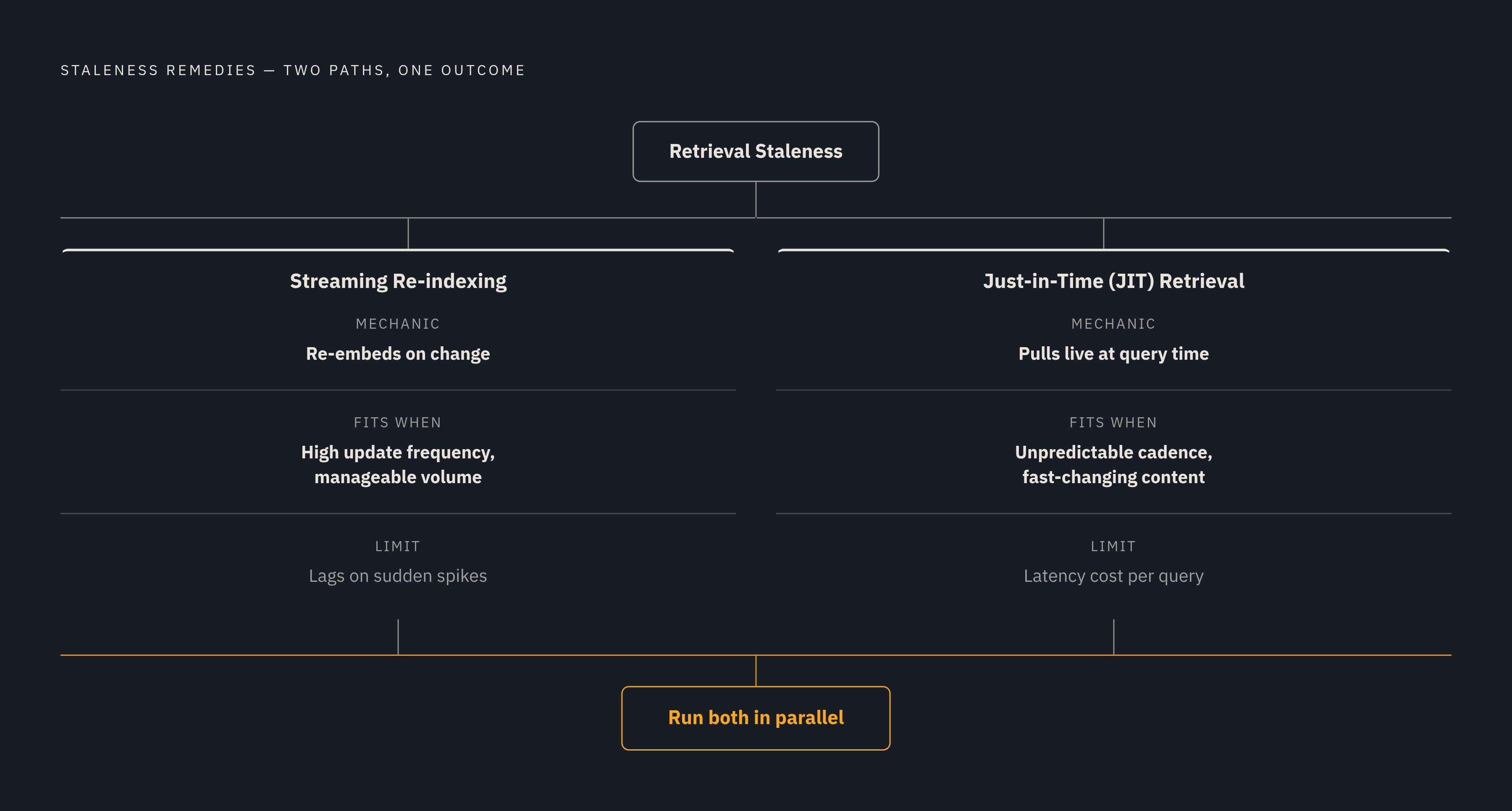
Once change detection is reliable, two architectural patterns emerge as the dominant responses to freshness decay, and they address different shapes of the same underlying need.
Streaming re-indexing treats the vector store as a continuously updated system rather than a periodically rebuilt one. Change events, whether from CDC, webhooks, or scheduled crawls, flow into an ingestion pipeline that re-embeds and re-indexes affected documents close to the moment they change. This pattern fits corpora where document volume is manageable and update frequency is high enough that even a daily batch job would leave the index meaningfully behind. It asks more of the infrastructure, since the ingestion pipeline has to run continuously and handle partial failures gracefully, but it keeps the index close to ground truth at all times.
Just-in-time retrieval takes a different approach: rather than keeping a static index perfectly current, it pulls live information at query time to supplement or override what the index returns. This is where retrieval systems that incorporate live web data, rather than relying solely on a static index, do work a vector store alone cannot. A search layer that surfaces current information alongside a relevance score gives the retrieval pipeline a way to check whether the world has moved since the index was last touched, rather than trusting the index's embedded snapshot of the world as permanently accurate. JIT retrieval suits corpora where update frequency is unpredictable, where the cost of re-indexing everything on a tight cycle doesn't make sense, or where the most current answer genuinely needs to come from outside whatever was indexed last.
Neither pattern replaces the other. Streaming re-indexing keeps a core knowledge base current for stable, high-volume content where re-embedding makes sense at scale. JIT retrieval handles the long tail of fast-changing or unpredictable information where re-indexing on a fixed schedule would always be a step behind. The choice between them, and the frequent choice to run both side by side, depends on query type and data volatility rather than on which pattern sounds more sophisticated. The research and the benchmarks covered earlier in this piece show that freshness is a property that has to be engineered, measured, and maintained with the same seriousness teams already bring to relevance.