Stateful vs. Stateless Search in Long-Running Agent Sessions
Preserve agent context through stateful orchestration, not stateless replay.
Long-running agent search is an architectural problem of preserving context without preserving mistakes or stale facts. The strongest design for variable-depth sessions combines stateless requests, stateful orchestration, and fresh retrieval from infrastructure such as Youcom. The choice is not whether to manage state, but where to keep it, who governs it, and how new evidence changes what the agent remembers.
Why the stateful/stateless distinction is an architectural decision, not a style preference
An agent confidently repeats an error that a developer corrected in an earlier interaction. The correction seemed to work, but the next request carries no record of it. This may be a failure to supply the information that would let the agent reason differently. Before changing the prompt, the developer has to establish where that correction was supposed to persist.
LLMs keep no record between calls unless the application sends the context again. What looks like memory in a chat framework is often client-side state returned with each request. The model has not remembered the exchange. The surrounding software has reconstructed it. A multi-step workflow still has to manage state even if it calls its agent stateless. It can only move responsibility to the client or application layer, where continuity, latency, and governance still have to be engineered.
What each model actually does at runtime and where the boundary sits
The runtime boundary is the load/store cycle for context. In a stateless loop, user input becomes a prompt, the model processes it, and the system returns output. There is no session lookup or database call for retained context, so everything the model needs must arrive in the current payload. In a stateful loop, the request carries an entity key, such as user_id, session_id, or workflow_id. The application loads stored context, combines it with the new input, calls the model and tools, computes the updated state, and writes it back.
That state includes more than conversation history, including preferences, workflow progress, tool results, extracted facts, and accumulated decisions. Memory is the selective part retained because it may matter in later turns. Across the four dimensions of memory, implementation complexity, scalability, and use cases, the models differ predictably. Stateless operation keeps no context of its own, has a simpler request path, can send requests to any free instance, and works well for tasks that stand alone. Stateful operation preserves context, requires persistence and coordination, may depend on session affinity or partitioned stores, and supports work with dependencies across steps. The model remains stateless in both cases. Orchestration makes the application context-aware.
Where stateless search breaks down as session length grows
For short, atomic tasks, stateless search leaves out machinery that does little to help. This gets harder when each answer depends on earlier exchanges. To preserve that dependence without server-managed state, the client must resend the history with each request. Payload size grows linearly with conversation length, while token spend follows transcript length regardless of the usefulness of its contents. A larger context window postpones the capacity limit but does not remove the cost of replay.
Eventually, the client must decide what to summarize or discard. That decision changes what the agent can know, making context selection an answer-quality responsibility. Consider a support agent that repeats qualifying questions because it has no record of previous contacts. A subject-matter expert corrects its assumption, but the correction survives only while the relevant context is supplied. Once that context is gone, another user must challenge the same mistake.
This becomes more consequential in a migration, audit, onboarding process, or complex claim spanning days or weeks. Such work needs a durable record of where it stopped and what comes next. A stateless agent can participate, but an external system must own that record. The design has not eliminated continuity costs. It has placed them outside the agent’s control. At enterprise volume, resending full histories can become prohibitive before the context window itself is exhausted.
Where stateful search introduces its own failure modes
Retaining context solves forgetting, but it makes correctness a continuing obligation. A stale read happens when another process changes state after the current process reads it. A partial write can leave an inconsistent record after a crash or timeout, while concurrent threads can overwrite each other through race conditions. Memory drift arises when the world changes but the stored account does not. Without checkpointing, a failure can also erase progress and force a long-running task to restart.
These are predictable engineering problems. They do, however, explain why a load/store example understates the production requirement. Stateful systems need concurrency control, retention policies, permissions, observability, and safeguards around what enters memory. They may also put a database on the hot path or require sticky sessions and partitioned stores. Stateless routing retains a genuine simplicity advantage.
Beyond those mechanics lies the harder problem of coherence over time. A long-running operation cannot safely assume that information stays fresh, that doing the same thing again does no harm, or that the original goal still holds. It needs belief revision and goal lifecycle management as the evidence and the situation change. The system must distinguish superseded findings from standing ones and trace decisions back to their evidence. Otherwise, the inverse of stateless forgetting appears, with a mistaken assumption persisting precisely because memory works.
How freshness of search results becomes a state problem in long-running sessions
A search result retrieved at session start may be stale by turn thirty. Running another search does not by itself resolve that problem, because the new result may conflict with an earlier finding still held in memory. Real-time retrieval supplies evidence that static training data cannot provide. The orchestrator still has to reconcile that evidence with what the agent already believes.
Two retrieval patterns address different needs. Pre-retrieval runs search before every model call, grounding each response but adding latency and cost even when fresh evidence is unnecessary. A hybrid retrieval pattern sends questions about internal documentation to a static knowledge base and questions about current events or external facts to live web search. That approach is more efficient, but routing introduces its own responsibility. The agent must retain source provenance and retrieval time so that older stored material does not silently acquire the authority of fresh evidence.
This is where a low-latency search API, such as those Youcom provides, becomes part of the state-update cycle. Its role is to supply current, cited information without making repeated retrieval the dominant delay. Infrastructure designed for low web search latency addresses that constraint, though retrieval speed alone cannot establish coherence. The application must still decide which findings revise earlier conclusions and which belong in the session record. A clean state record is useful only while its relationship to the changing world remains visible.
How multi-agent systems make state management harder and interoperability essential
When one agent hands work to another, continuity crosses an ownership boundary. The receiving agent needs more than the latest message if its next step depends on earlier decisions, unresolved conflicts, or source evidence. Without an explicit handoff design, an error in one agent’s memory can become another agent’s starting assumption. The handoff design must specify what context crosses the boundary and what grounds its authority.
The ICML 2026 position paper Position: Collaborative Agentic AI Needs Interoperability Across Ecosystems argues that isolated development is producing fragmented, incompatible agent ecosystems. Its proposed WEB OF AGENTS foundation has four building blocks, namely agent-to-agent messaging, interaction interoperability, state management, and agent discovery. With state management among those primitives, the infrastructure has to keep work on track, so memory is no longer a feature that can be left out. Existing protocol efforts introduce useful primitives, but distinct abstractions and data formats do not automatically interoperate. Builders therefore need to specify what state is passed, in what format, and with what provenance, while accounting for the consistency and security risks of the handoff itself.
Privacy and compliance exposure that stateful architectures add to agent deployments
The same retained information that makes an agent useful also expands its data obligations. Personal information can exist in memory, embeddings, logs, and source database rows. A right-to-erasure request under GDPR therefore calls for more than deleting the original user record. Inferences and derived attributes may remain in agent memory even when they were never stored in the source system. A retention design is incomplete if it cannot account for those copies and derivations.
The Dutch Data Protection Authority warned in February 2026 that open-source autonomous AI agents that need broad access to systems bring serious risks to security and data protection. It also said that organisations and users remain responsible for GDPR compliance regardless of whether the software is open-source. That responsibility means data sensitivity must shape the design before deployment, when it might otherwise be reviewed. A stateless agent that retains neither user data nor execution traces has a structurally smaller leakage surface. Shifting storage to a client leaves that client’s obligations in place.
Infrastructure choices belong in the same assessment. For enterprise deployments, the notes’ requirements of zero data retention and SOC2 certification apply to the search layer as well as the memory store. An evaluation of Youcom or another retrieval approach must therefore include that infrastructure posture alongside answer quality and speed.
The hybrid pattern that production teams now use to get continuity without forfeiting scalability
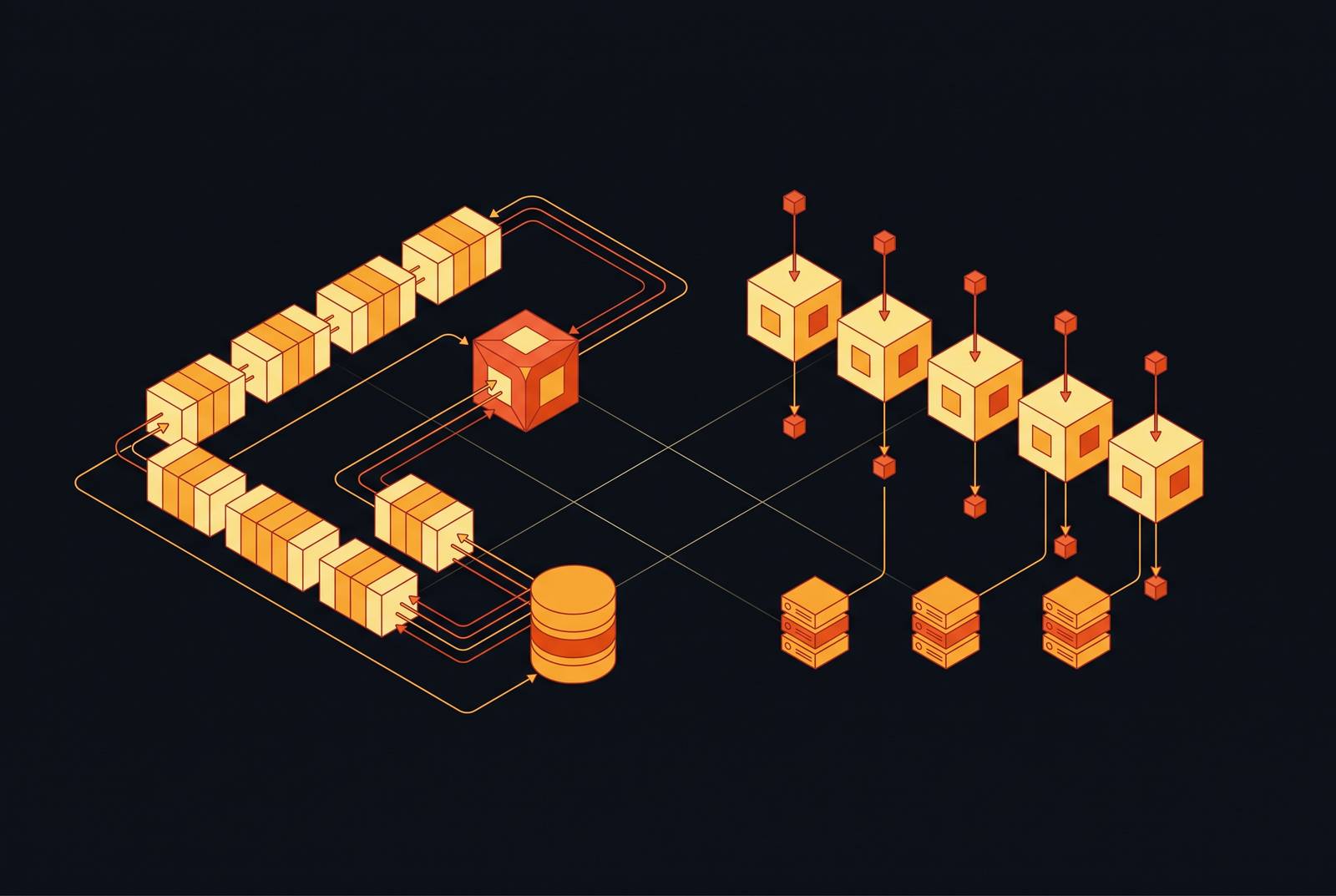
The practical resolution is a stateless frontend backed by a stateful orchestrator. Sending a new message and an identifier frees the client from rebuilding an ever-longer transcript. Behind the API boundary, the orchestrator loads the appropriate context, processes the request, and updates state. Request routing can remain horizontally scalable while a managed layer owns continuity. That separation also lets a workflow pause for a slow tool call or human approval and pick up where it left off.
Four memory tiers divide the work rather than treating retention as one undifferentiated store. In-context working memory holds the current turn, the tool calls now in progress, and the reasoning chain for the work at hand. An external key-value tier, such as Redis, holds current conversation context, active tasks, and recent tool outputs, with sub-millisecond retrieval and a short retention window. Episodic logs record what happened, what was decided, and which sources were consulted, providing timestamped provenance. A semantic vector tier holds summarized past interactions, learned preferences, and resolved issues for retrieval across sessions.
The runtime governs how those tiers support action. It owns session state, tool execution, checkpoints, policy checks, secrets, traces, cost limits, and deployment shape. The model chooses the next action, while the runtime determines where it executes, whether it is allowed, how it is recorded, and how work resumes after failure. This is the distinction between attaching memory to a prompt and operating a durable workflow.
Youcom’s Web Search API and Research API fit this pattern by supplying cited, real-time retrieval when called. The search call need not retain session state, because the orchestrator owns the record across calls. Search results can go into working context and episodic logs, while their evidence helps shape changes to longer-term summaries. The important boundary is that retrieval supplies current information and orchestration decides what persists.
How to choose the right architecture for a given session depth and data requirement
Choose stateless operation when tasks are single-turn or fewer than roughly five turns with no dependencies between them. Classification, one-shot Q&A, code explanation, and isolated command execution fit this pattern because they do not inherently require remembered progress. When data sensitivity is high and there is a zero-retention requirement, there is also a stronger case for statelessness. So does a primary need for horizontal scalability without session affinity.
Choose stateful orchestration when later steps depend on earlier decisions or when work must survive interruption. Migrations, audits, onboarding programs, and complex claims need a durable point of resumption. Corrections, preferences, and accumulated findings also require persistence when they must outlast an interaction. Multi-agent workflows add the requirement that context survive handoffs. Where session depth varies, the hybrid pattern accommodates those needs without forcing every request path to retain state.
Finally, choose retrieval infrastructure against freshness, latency, and provenance requirements rather than treating search as an interchangeable tool. Pre-retrieval must be fast enough to run again and again without taking up most of the response time, while episodic logs need citations that show what decisions were based on. Youcom’s cited, real-time retrieval is one fit for those requirements, but it does not replace state governance. The unresolved dependency is how the search layer keeps durable memory grounded as the world changes, and that deserves the same architectural attention as the memory store itself.