Web Search API Comparison for LangChain and LlamaIndex Agents
LlamaIndex handles retrieval, LangGraph handles orchestration, each needs different search APIs.
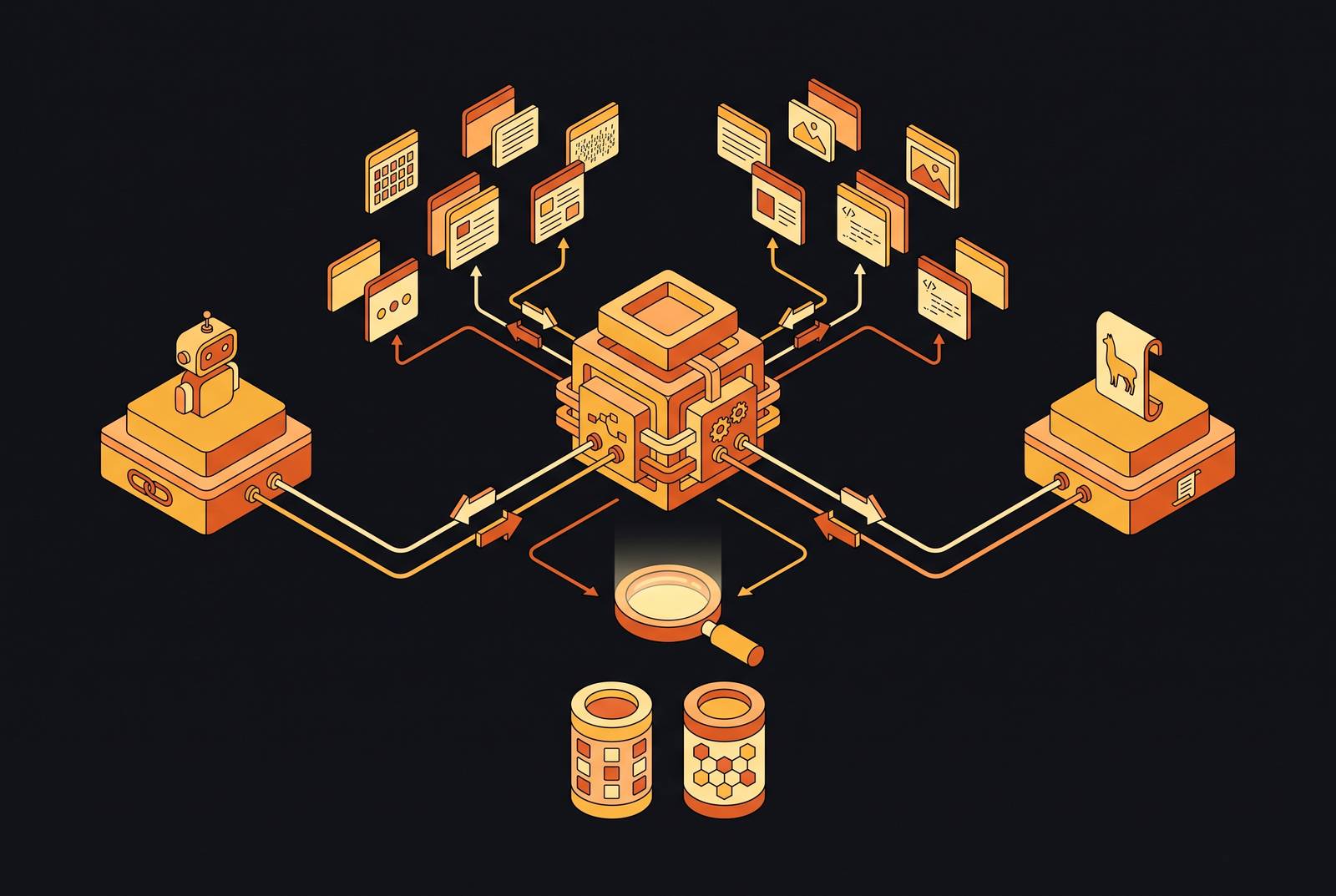
LangChain and LlamaIndex have settled into two different jobs, and that split is the reason there is no single right answer to "which web search API should an agent use." LangGraph, the orchestration runtime inside the LangChain ecosystem, handles the control layer: stateful execution, branching, cycles, retries, human-in-the-loop approvals, and coordination across multiple agents working the same task. Its persistence layer lets a long-running workflow survive a crash or a multi-hour wait on human input, picking context back up where it left off.
LlamaIndex, by contrast, is built around the data layer. Its job is ingesting messy inputs, indexing them, and pulling context back out with a level of control that plain retrieval-augmented generation can't match once the documents get complicated. LangChain's own comparison of the two frameworks lists a set of LlamaIndex retrieval primitives with no direct equivalent on the LangChain side: hybrid search, recursive retrieval, query decomposition, sub-question generation, hierarchical node parsing, and auto-merging. LlamaIndex also offers more ways to structure what gets retrieved, through index types like VectorStoreIndex, SummaryIndex, TreeIndex, KeywordTableIndex, and PropertyGraphIndex, each suited to a different shape of content or query. LlamaParse, the parsing layer that handles much of this, reads more than 130 file formats and over 100 languages, reading layout the way a person would, separating charts and tables and images from running text instead of flattening everything into a single stream. That makes retrieval quality over messy private data largely a LlamaIndex problem to solve, not a LangChain one. A 2026 comparison from Nutrient states the practical tradeoff: LlamaIndex has a shorter learning curve for basic RAG, while LangChain hands developers more building blocks. That means more work up front but more room to maneuver later.
None of this plays out as a choice between the two frameworks in production. LangChain's own guidance describes stacks that run LlamaIndex for retrieval, LangGraph for orchestration, and LangSmith for the feedback loop that improves the agent over time. LangSmith works the same regardless of which framework sits underneath it. It works with LangChain, LangGraph, LlamaIndex, the OpenAI SDK, the Anthropic SDK, the Vercel AI SDK, and custom code built from scratch. That combination matters for anyone picking a web search API, because the decision is really several decisions bundled together. The retrieval calls LlamaIndex fires off and the tool calls LangGraph dispatches carry different latency tolerances, expect different output formats, and fail in different ways. A search API that fits one layer well might be a poor match for the other, even inside the same pipeline.
Web search as a required primitive in both stacks
Every large language model answers from a training set that stopped updating on a fixed date, so both halves of this stack run into that wall, but from different directions. LlamaIndex's retrieval engine and LangGraph's tool-calling loop hit the same ceiling the moment a query needs something the model was never trained on. Why does this happen at the architecture level rather than just showing up as an occasional wrong answer? Because the failure is temporal by design: an LLM answers from what it learned, and what it learned necessarily lags the present by months or years.
For a LlamaIndex pipeline, that means the private knowledge base, however well-indexed, needs supplementing with open-web retrieval any time a query touches current events, a competitor's latest move, or anything that happened after the index was last built. For a LangGraph orchestration loop, if a multi-step research task has no tool call to a web search API, it can slide into hallucination, where the agent fills gaps with plausible-sounding invention when it doesn't know the answer.
A second failure mode gets less attention but matters just as much inside agentic loops: query drift. As a model iterates across steps, rewriting its own search queries along the way, it can wander from what the user actually asked. The fix is a normalization step, anchoring the query semantically before it ever reaches the search API, so each iteration still points back at the original intent rather than at the model's last, possibly garbled, restatement of it. This pattern is more visible in LangGraph's multi-step loops than inside a single LlamaIndex retrieval call, since LlamaIndex's typical pattern doesn't ask the model to rewrite queries across five or six sequential hops the way an orchestration loop does. That makes drift control an orchestration-layer concern more than a retrieval-layer one.
Out of both failure modes, a standard pattern has emerged: route each query to either a static knowledge base or a live web API, depending on what kind of question it is. If a question touches internal documentation or private data, it goes to the vector index. Current events, outside research, and anything time-sensitive go to the web search API. LlamaIndex's query routing primitives make this split easy to build directly into the retrieval layer, while LangGraph's branching logic handles the identical decision at the orchestration layer instead. The production stack that combines LlamaIndex for retrieval, LangGraph for orchestration, and LangSmith for the feedback loop also needs a search layer that can sit transparently underneath all three without forcing custom glue code between them. Youcom's MCP server integration and its Contents API both fit that requirement, so you can add real-time web grounding wherever a given layer needs it instead of rebuilding the connection for each framework separately.
A standardized protocol now connects tools to models, so search has moved from a custom integration to something closer to a baseline expectation. Any provider that exposes an MCP server can plug into any MCP-compatible client, Claude Code, Cursor, VS Code, or a LangGraph tool node, without a team writing a bespoke adapter for each one.
The three categories that separate web search providers
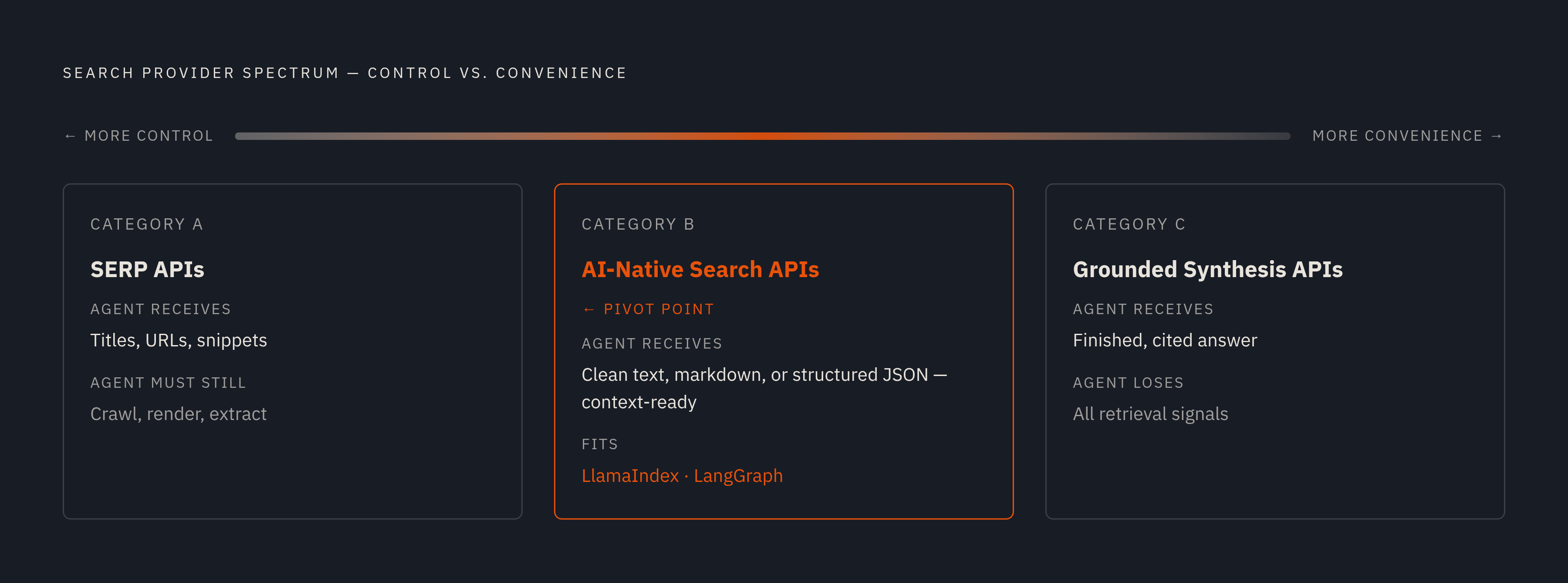
Before comparing providers by name, a builder has to answer a more basic question: which layer of the retrieval stack is actually being bought? The category a provider falls into determines how much retrieval logic the agent's own code still has to carry.
Category A covers SERP APIs, the ones that hand back titles, URLs, and snippets pulled from an existing search engine. The agent still has to crawl the pages, render them, and extract usable content on its own. This category fits rank tracking, coverage across multiple search engines, and access to Google verticals like Scholar, Patents, or Shopping, anywhere the agent genuinely needs to see what a human searcher would see. It fits RAG and agentic loops poorly, because scraping full pages drags in navigation menus, boilerplate, and ads along with the real content, which dilutes the signal a model reasons over and drives up token costs at the same time.
Category B covers AI-native search APIs, which combine discovery and extraction into a single call and return text, markdown, or structured JSON that's already ready for a context window, often pulled from a proprietary or semantic index. This is the category you build RAG pipelines, agent tool calls, and multi-hop reasoning on, where content arrives clean and skips a second processing pass. The failure mode here looks different from Category A. Instead of noise, a Category B provider can hand back documents that are simply the wrong ones. Relevance ranking, not extraction quality, is where these providers actually separate from each other.
Category C covers grounded synthesis APIs, which skip straight to a written, cited answer, so the agent is left with very little retrieval logic to control. The appeal is obvious: less engineering overhead and a finished answer to work with. The failure mode is harder to catch because the answer sounds confident, and you can't always inspect its provenance closely. For a LlamaIndex pipeline where citation integrity is a core requirement, that opacity becomes a structural problem, since the agent has no way to confirm what the synthesis API actually pulled before writing its answer. For a LangGraph agent that needs to branch its next step based on what the evidence actually says, a black-box answer removes exactly the intermediate signals that branching logic depends on.
One might argue that the category a provider falls into settles which provider a team picks before the comparison even starts, and for a lot of teams, it does. LlamaIndex retrieval pipelines almost always want Category B, because LlamaIndex already owns the query engine and the chunking logic. What it needs from an external API is clean, extractable content, not a finished answer it can't take apart. LangGraph orchestration loops have more room to choose between Category B and Category C, because it depends on whether the steps downstream need to inspect the evidence directly or just act on whatever conclusion comes back. Neither framework is served well by Category A for AI workloads. The extra scraping step adds latency and token cost at exactly the moments in an agentic loop when speed is what matters most.
Mapping leading providers to LangChain and LlamaIndex workloads
Picking a provider is a fit question, not a leaderboard question. The right API is whichever one matches its category, its output format, its latency profile, and its integration depth to the layer actually doing the retrieval work, not whichever one scores highest on a single benchmark.
Youcom's Web Search, Contents, Research, and Finance Research APIs are the strongest fit among current options for production LangChain and LlamaIndex stacks that need grounded, cited retrieval across more than one kind of workload. The Web Search and Contents APIs are in Category B, so they combine discovery and extraction in one call. The Research API crosses into synthesis territory but keeps full source citation attached, so you can use it both at the LlamaIndex retrieval layer and at the LangGraph tool-call layer, depending on what a given step needs. Youcom's product documentation describes five distinct APIs in total, Web Search, Answer, Contents, Research, and Finance Research, each returning structured, LLM-ready output with sources cited directly in the response. That maps cleanly onto the retrieval pattern LlamaIndex pipelines are usually built around, where every claim the system makes needs a source attached to it.
On benchmarks, the Research API previously held the top position on DeepSearchQA, though as of late 2026 it no longer leads that leaderboard. The Finance Research API currently ranks first on FinSearchComp's T2 sub-benchmark for Simple Historical Lookup, a publicly published result rather than a self-reported figure, which matters for teams trying to compare providers on something other than marketing claims. On the compliance side, you get zero data retention and SOC 2 compliance on Youcom's custom Enterprise plan, which matters directly if you run a LangGraph pipeline inside a regulated environment where data handling has to be auditable. MCP server availability lets the same APIs plug into LangGraph tool nodes or LlamaIndex tool specs without custom adapter code on either side. Access starts with a free tier, with self-serve available for most paid tiers, though some features, including the Research Frontier tier and higher rate limits, require negotiated access. The Finance Research API gives agents a purpose-built path to cited financial intelligence, and that workload is distinct enough from general web search that you can treat it as its own category of need. For multi-step agent loops specifically, Youcom's Research API addresses query drift directly: it delivers live, semantically anchored retrieval in a single call, which removes the iteration-by-iteration drift that tends to creep into LangGraph orchestration while still running fast enough that the LlamaIndex side of a pipeline feels instantaneous to whoever's waiting on the other end.
Grounding with Bing Search, now folded into Azure AI Agents, Azure AI Search, and Foundry Knowledge, descends from the SERP lineage but has narrowed to an Azure-only option since Microsoft retired the standalone Bing Search APIs in August 2025. If a team is already committed to Azure infrastructure, this is the path of least resistance, because it already sits inside the same ecosystem as everything else they're running. Teams on a mixed stack or outside Azure entirely inherit the lock-in that comes with it instead. It isn't a Category B, AI-native API: content extraction remains a separate step, which brings the same token bloat problem back into a LlamaIndex pipeline that a true Category B provider would have avoided.
OpenAI's web_search and Anthropic's Claude web_search are in Category C, as native model tools with the lowest integration overhead you can get, and correspondingly, the highest provider lock-in. The model itself decides when to search and folds the results straight into its own output, so there's no separate retrieval pipeline to build or maintain, but also no retrieval layer left to inspect, tune, or route around. If a team is already committed to a single model provider and wants grounding without standing up a retrieval stack of its own, that tradeoff fits. It fits poorly for an agent that needs to branch based on what the retrieved evidence actually says, since there's no intermediate evidence to branch on. This category of tool barely existed two years earlier, and it has grown fastest among teams that treat retrieval as a solved problem.
Cloudflare AI Search, formerly known as AutoRAG, deserves mention for a different reason: it runs managed RAG over a corpus a team supplies itself, not live open-web retrieval. It appears often enough in the same buying conversations as web search APIs that the two decisions need separating explicitly. If a team compares Cloudflare AI Search against a Category B web search provider, they are solving two different problems, indexing a known corpus versus reaching the open web, and if you conflate them, you tend to get a worse decision on both fronts.
Put together, the shape of the comparison tracks back to the architecture laid out at the start. LlamaIndex wants clean, structured, citable content it can slot into its own query engine. LangGraph wants a tool call that fits whatever a given step in the loop needs: sometimes evidence to branch on, sometimes a finished answer to act on. No single provider wins every layer of that stack by default, but the category framework at least turns the provider comparison into the right question.