Chunking Strategies for Live Web Content in RAG Pipelines
Query-time fetching forces a rethink of how web pages get split.
A compliance team asks its RAG assistant whether a new vendor contract requires a specific indemnification clause. The retriever finds the right document. It delivers a chunk split at the wrong paragraph boundary, and the exception clause that changes the answer sits just past the cut. This piece is about why that failure happens specifically with live web content, and what a chunking strategy has to do differently when the source material is a page that didn't exist when the pipeline was built.
Why live web content breaks standard RAG chunking assumptions
Standard RAG chunking assumes a stable corpus: documents get split, embedded, and indexed once, and the resulting chunks are stored in a vector store waiting for queries. Live web RAG breaks that assumption at the root, because the content a query needs may not have existed when the system last indexed anything, so chunks have to be generated or validated at query time rather than pulled from a pre-built cache. The staleness that results has two separate components, and they compound rather than cancel. A page published after the last crawl is simply missing from the index, no matter how good the retrieval technique is; that's the coverage gap. A page that was indexed but has since changed leaves old embeddings pointing at text that no longer exists on the live page; that's the drift gap. Running crawls more often narrows both gaps, but it never closes either one, and it burns compute re-indexing pages no query will ever touch. The only fix that addresses the structure of the problem, rather than papering over it, is moving the fetch itself to query time: discover and retrieve the handful of pages a specific question actually needs, instead of trying to pre-fetch the entire web and hope the right page survived in the index. Once fetching happens at query time, chunking can't be a static, pre-computed step either. Chunks have to be generated or validated under real latency constraints, against web pages with unpredictable structure, under freshness deadlines that determine how long a chunk can be trusted before it needs to be refreshed. That requirement is the architectural fact the rest of this piece works through.
The seven-stage live-web RAG pipeline
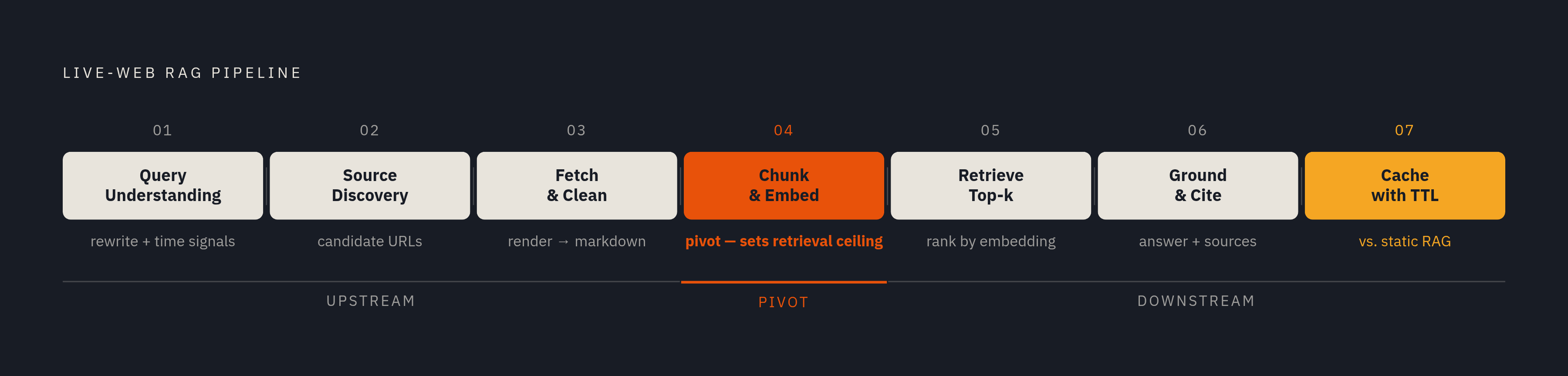
Chunking doesn't operate in isolation. Everything upstream of it (how the query gets interpreted, which sources get discovered, how those pages get fetched and cleaned) constrains what a chunker has to work with, and everything downstream (embedding, retrieval, grounding, caching) inherits whatever the chunking step hands it. Chunking is not an isolated step: a decision made at the chunk stage propagates errors or efficiencies through everything that comes after it, including retrieval and grounding.
A live-web RAG pipeline runs through seven stages in sequence. Query understanding rewrites the user's raw question into something closer to search intent and pulls out signals about how time-sensitive the question is. Source discovery sends that rewritten query to a search API and gets back candidate URLs, and this is where a surprising number of pipelines fail quietly, because a model can't ground an answer on a page it never found in the first place. Fetch and clean renders each candidate URL into clean markdown. Chunk and embed, the stage this piece is about, splits that markdown into pieces and embeds them at query time. Retrieve top-k ranks those chunks against the query's own embedding. Ground and cite has the model answer using only the retrieved chunks, with links back to source. Cache with TTL stores the resulting chunks with a freshness deadline attached, so they can be reused later if they're still valid, and this caching layer is the single architectural feature that separates a live-web pipeline from a static one.
That TTL cache produces a hybrid pattern that most production systems end up converging on: fetch live when a query is clearly time-sensitive, reuse a cached chunk when a recent one is still within its freshness window. Any chunking decision has to work for both of those paths. It also means the "vector store" in this kind of pipeline often looks nothing like the persistent index static RAG assumes. It's frequently small, short-lived, and scoped to a single query or session, which is a genuinely different operating environment than a vector database built up over months of static indexing. Chunking sits at the pivot point in this chain: it inherits every constraint fetch-and-clean hands it, and it determines how much signal retrieval has to work with. The next section looks at what happens when that upstream input isn't clean.
Clean markdown at ingestion is a prerequisite
Web pages are navigation bars, cookie banners, ad slots, JavaScript-rendered widgets, and heading structures that vary wildly from one site to the next. Feeding raw HTML straight into a chunker makes the chunking strategy irrelevant, because no algorithm, however well-designed, produces good chunks from bad input. Clean markdown solves this before chunking even starts: it strips out navigation, ads, and boilerplate, and it does so while cutting the token count the pipeline has to process.
Two separate downstream problems make this a prerequisite rather than a nice-to-have. The token cost is direct: every token spent embedding a cookie notice or a nav bar is a token the retriever later has to work around, and at query-time latency budgets, that waste is not free. The second, structural problem is that chunking strategies relying on document structure, recursive splitting and document-structure-aware chunking among them, depend on reading heading and paragraph signals to find good split points, and HTML noise destroys those signals before the chunker ever sees them. Clean markdown is what exposes them reliably.
That puts real weight on the fetch-and-clean stage, because a search API's content extraction capability determines how much pre-processing failure the rest of the pipeline inherits. An API that returns clean, structured markdown directly removes an entire category of problems that would otherwise have to be handled, imperfectly, downstream. This is the bridge between architecture and strategy: the quality ceiling on any chunking approach is set by how clean the input already is before chunking begins, and the strategies covered later in this piece all assume that ceiling has already been raised.
The core tension every chunking decision must resolve
Retrieval wants chunks small enough that each one captures a single clear idea, because a focused chunk produces a precise embedding that vector search can match confidently against a query. Generation wants the opposite: once something is retrieved, the model needs enough surrounding context to actually answer the question, and a single sentence pulled out of the middle of a technical document often carries no usable meaning on its own.
A third factor makes oversized chunks worse than they'd otherwise be. Researchers at MIT and Google Cloud AI documented a U-shaped attention bias in large language models, often called the "lost in the middle" effect, where the beginning and end of an input get disproportionate attention regardless of what's actually relevant there. A chunk padded out to maximize context ends up burying the useful part in the section the model is least likely to weigh heavily. There's a related cost that's easy to miss: when a chunk contains two or three unrelated topics, the single embedding vector representing that chunk can't represent any one of those topics precisely, so cosine similarity scores flatten out and top-k retrieval starts returning less reliable results. Smaller, focused chunks avoid this; oversized or mixed-topic chunks invite it.
What shifts the right answer isn't a universal rule but the query pattern a pipeline is actually serving. Short, factual lookups do best with smaller chunks, which prioritize precision over context. Questions that require connecting information across multiple paragraphs or sections do better with larger chunks or even page-level chunking, which prioritize completeness over precision. Every strategy covered next is, in some sense, an attempt to resolve this tension in a specific direction for a specific kind of document and query.
How the seven strategies compare
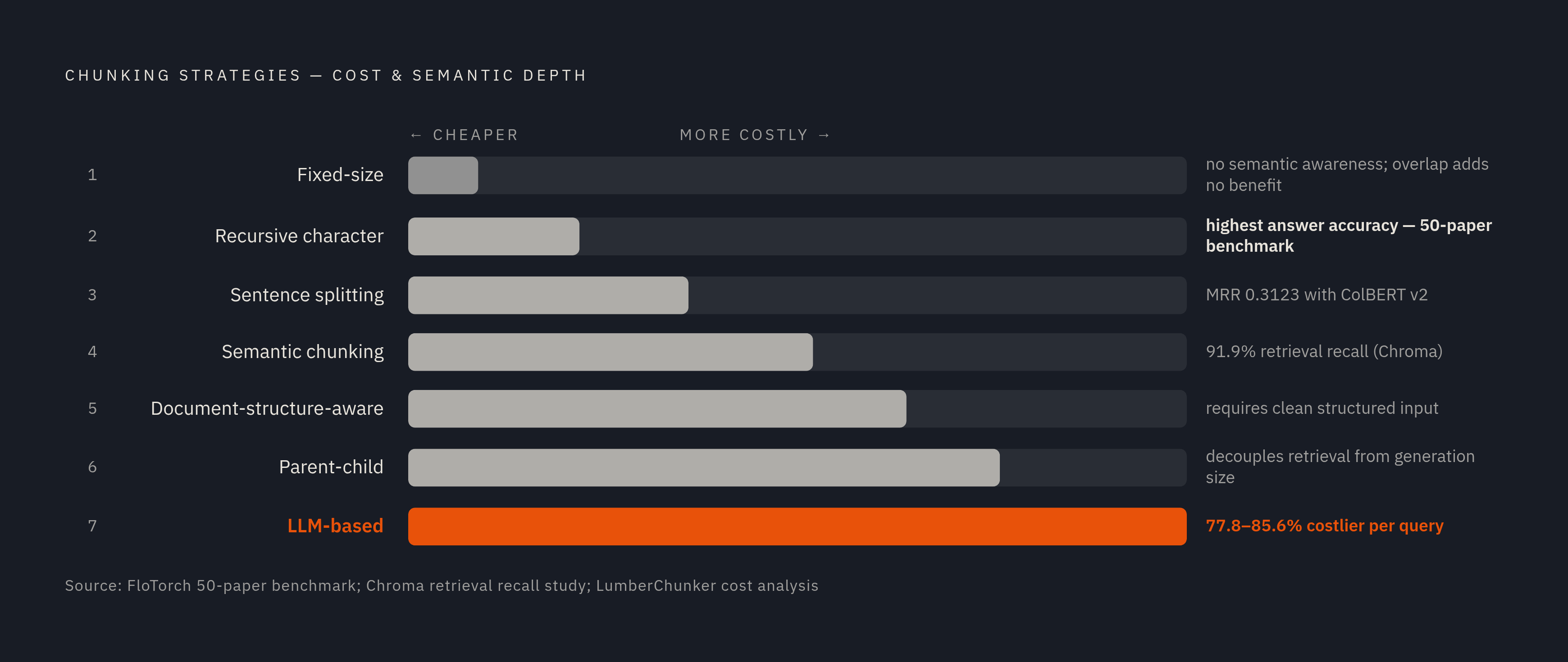
Seven chunking strategies cover the range from cheapest and most deterministic to most semantically aware and most expensive, and which one fits depends on the document's structure, the query pattern it needs to serve, and how much latency budget a live-web pipeline can spend on the chunking step itself, not on which one wins a single benchmark.
Fixed-size chunking is the simplest: split every N characters or tokens, optionally with some overlap between chunks. It works as a baseline for prototyping and for uniform content like short Q&A pairs or product descriptions. An analysis found that overlap added no measurable benefit and only increased indexing cost when paired with SPLADE retrieval, though a small amount of overlap still helped with dense-only retrieval. Fixed-size chunking tends to fail on structured or multi-topic documents, since it splits mid-topic and merges unrelated ideas with no regard for where one ends and the next begins.
Recursive character splitting tries a sequence of separators in priority order, double newline, then single newline, then sentence, then space, so it uses the most meaningful break available within the target chunk size rather than cutting blindly. FloTorch's benchmark, run across 50 academic papers, found that recursive splitting at a moderate token budget produced the highest end-to-end answer accuracy of any strategy tested, beating every more expensive alternative in the comparison. That makes a moderate chunk size with small overlap and a standard separator hierarchy a reasonable starting configuration, and it's the production default for most pipelines. Its limitation is that it still ignores semantic boundaries: a paragraph about pricing can merge with an unrelated paragraph about security features if both happen to fit inside the same token budget. For analytical queries that need multi-paragraph context, a larger starting token budget tends to work better than a minimal one.
Sentence splitting segments text at sentence boundaries and suits conversational content, transcripts, and short Q&A exchanges well. Paired with ColBERT v2, sentence-level chunking achieved the best mean reciprocal rank in the 2026 benchmark landscape, at 0.3123. It tends to break down on long technical documents, where a single sentence carries little meaning without the paragraphs around it.
Semantic chunking embeds each sentence, measures the cosine similarity between consecutive sentences, and opens a new chunk boundary wherever that similarity drops below a threshold, aiming to produce chunks that track coherent topics rather than arbitrary token counts. Its performance story is more complicated than it first appears. Chroma's testing measured 91.9% retrieval recall for semantic chunking, but FloTorch's end-to-end benchmark found meaningfully lower answer accuracy for the same approach, and the gap traces back to fragment size. Without a minimum size floor, semantic chunking tends to produce very short fragments that retrieve well in isolation but hand the model too little context to generate a complete answer. Setting a minimum chunk size and merging adjacent fragments that fall below it fixes most of this. Semantic chunking suits heterogeneous corpora and mixed-topic documents when retrieval recall matters most, though it's expensive to run under a tight latency budget.
Document-structure-aware chunking respects heading hierarchies, section boundaries, and markup signals in Markdown, HTML, or code, producing chunks that line up with a document's own logical sections rather than an arbitrary size target. Denser Chat's production pipeline offers a concrete example of this in practice: it routes by document type, using page-level chunking for PDFs and recursive splitting for web pages, with every document type passing through a hybrid retrieval pipeline that combines dense and sparse retrieval with a reranker. That routing, rather than one strategy applied everywhere, is the more realistic picture of how production systems actually use these approaches. Document-structure-aware chunking needs clean, structured input to work at all; that is why the clean-markdown prerequisite from the earlier section matters here. It offers little value on unstructured prose that carries no markup signals to exploit.
Parent-child, or hierarchical, chunking stores a larger parent chunk for generation alongside smaller child chunks for retrieval, so retrieval operates on the children while generation draws on the parent each child belongs to. This directly answers the retrieval-generation tension from the previous section: the child chunk is sized for embedding precision, and the parent chunk is sized for context completeness. It carries more implementation complexity than the strategies above it and suits long reports, legal documents, and manuals where a reader (or a model) needs both precise retrieval and full context.
Late chunking inverts the usual order entirely: it embeds the whole document first, through a long-context embedding model, and only then carves chunk-level representations out of the full-document token embeddings, so every resulting chunk embedding still carries long-range context from the entire source. This proves especially useful for documents full of cross-references, where a given passage only makes sense in light of something stated elsewhere in the same document. It costs more to embed than recursive splitting, a cost that's easier to justify on long documents where losing cross-reference context would otherwise cost the pipeline something larger in accuracy.
Across all seven, no single published benchmark measures both retrieval quality and generation quality together under the freshness constraints a live-web pipeline actually operates under. The numbers above come from static-corpus testing. That gap matters for the next question: when the quality of a chunking approach can't be fully verified by benchmark alone, and the cost of getting it wrong is high, does it make sense to hand the job to a language model directly?
The high cost of handing chunking directly to a language model in live-web pipelines
LLM-based chunking produces real gains in semantic coherence, but it introduces a cost and determinism problem that fits poorly with high-volume live-web ingestion, where chunks need to be produced at query time rather than during a batch indexing run done once overnight.
LumberChunker makes the strongest case for this approach: it prompts a language model to find natural content transitions and treats those transitions as chunk boundaries. Integrated into a full RAG pipeline, it produced higher QA accuracy than fixed-size and simpler splitting methods, and in some contexts it matched Gemini 1.5 Pro's performance. The quality case for letting a model decide where chunks begin and end is genuine.
The cost case against it is just as concrete. Every chunk produced this way needs its own separate LLM generation call, and D-RAC research puts the resulting cost at 77.8 to 85.6% more than alternatives that match or exceed its performance on standard benchmarks. For a pipeline that produces chunks once, offline, against a fixed corpus, that cost gets amortized over months of reuse. For a live-web pipeline producing chunks at query time across a high volume of queries, that same cost recurs on every single query, and it compounds into a latency and cost penalty that static pipelines simply never have to absorb.
A middle path avoids paying that cost everywhere while still capturing some of the semantic benefit. Run recursive splitting as the default first pass, since it already performs well on its own. Then run a lightweight classifier over the resulting chunks to flag the ones that span more than one topic. Only the flagged chunks, a fraction of the total, get sent through an LLM for re-splitting.
Sources
- Chunking strategies for RAG pipelines: A practical guide for 2026
- Knowledge Compression via Question Generation: Enhancing Multihop Document Retrieval without Fine-tuning
- Web Retrieval-Aware Chunking (W-RAC) for Efficient and Cost-Effective Retrieval-Augmented Generation Systems
- Optimizing RAG Pipelines for Arabic: A Systematic Analysis of Core Components
- Chunking Strategies RAG 2026 : Best Ways to Split Data for Production