Search API Provider Selection Criteria for Enterprise AI Teams
Four ordered gates—compliance, accuracy, latency, cost—protect enterprises choosing search APIs.
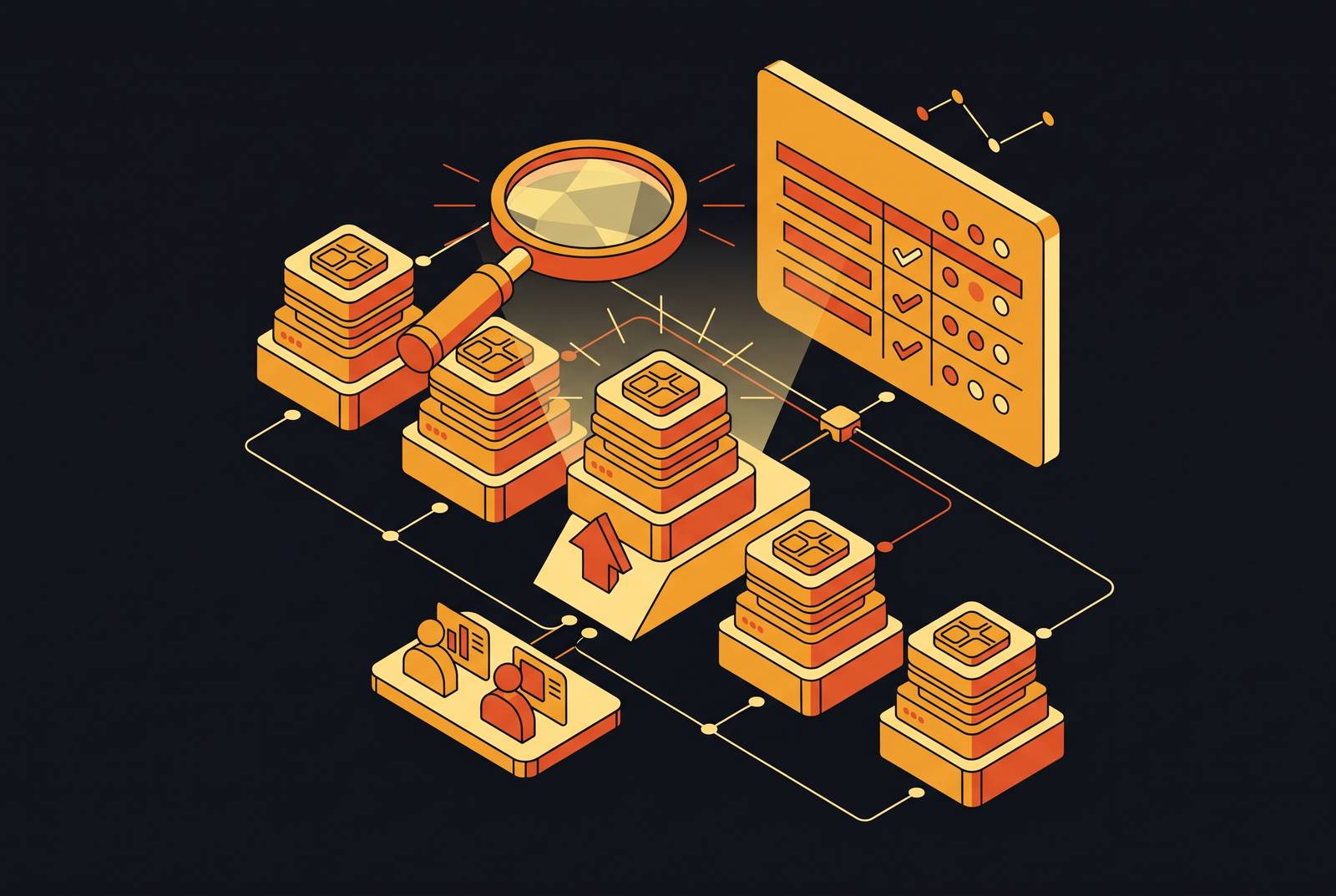
Selecting a search API for enterprise AI is a decision about retrieval infrastructure, including search performance. A defensible choice requires four gates in order, namely compliance, retrieval accuracy, latency at scale, and true total cost. That order keeps teams from testing vendors they cannot deploy or choosing low query prices that hide costly failures in production.
Why the search API decision has fundamentally changed for enterprise AI teams
A search API now helps determine what evidence an AI agent can use when answering a question. At inference time, retrieval anchors output in live, citable material rather than leaving the model dependent on static training data. Can the service support grounded enterprise output? A useful search result is no longer the end of the workflow but an input to another system’s reasoning.
Relying on the service also puts the infrastructure at risk in ways a good demonstration cannot rule out. Microsoft retired every Bing Search API on August 11, 2025, so teams built on those services had to re-platform. An inherited choice became an explicit architectural decision. Teams now have to choose an index and assess whether the service around it can support their agents in production. The urgency is therefore not just to find a replacement or a faster endpoint, but to establish a method before vendor comparisons begin.
Why evaluating criteria in the wrong order wastes procurement cycles
An evaluation spreadsheet is structured backwards when a vendor can offset a disqualifying requirement with strong scores elsewhere. A fast response cannot make up for data processing that fails the team’s requirements. Yet testing that response can consume engineering time before anyone discovers the legal blocker. The first question should therefore be which requirements can end the evaluation without a deep technical trial.
This is an elimination sequence. Pass/fail requirements come first because they can remove a vendor through documentary evidence. Performance tests follow because they require instrumentation, representative workloads, and time. The four axes are compliance, benchmark accuracy, latency at scale, and true total cost, applied in that order.
Why leave cost until the end when budgets constrain every purchase? Because the cost that matters depends on what the earlier tests show. Retry loops, poor retrieved context, and compliance rework can overturn a nominal price advantage. Price per query is visible before testing, but that does not make it a sound first filter. The sequence delays the cost judgment until the team has evidence to support it.
Compliance as the first elimination gate, not a feature to compare later
When a search API processes queries containing personal data on an enterprise’s behalf, its role as a data processor under GDPR requires attention before performance testing begins. The procurement record needs a Data Processing Agreement, a defined retention policy, and a lawful basis for any transfer outside the EU. These are deployment conditions. For a system classified as high-risk under the EU AI Act, documentation of third-party data sources, including search results, also belongs in the compliance assessment.
At this gate, teams check SOC 2 Type II, zero data retention, EU data residency, and bring-your-own-cloud deployment against what the organization requires. Regulated workloads can narrow the field further through HIPAA, FedRAMP, or strict residency obligations. The lesson for procurement is to request the signed DPA and current sub-processor list, establish whether ZDR is the default or an optional upgrade, and obtain documentation of where queries are processed. If the vendor cannot produce the required evidence, the evaluation ends.
Deployment language needs particular care at this gate. Data residency does not prove that queries stay inside the enterprise’s private cloud network. A BYOC arrangement in which queries never leave that boundary differs from a hosted service processing them in an approved region. The distinction is between a third-party query flow that must be explained to an auditor and one that does not exist.
How to measure retrieval accuracy before trusting a vendor's benchmark claim
Once a vendor clears compliance, its accuracy claims become worth testing. But accurate at what task, under which retrieval conditions? A single leaderboard score cannot answer both questions. Short factual retrieval and open-ended research place different demands on the same endpoint, so benchmark relevance must precede benchmark rank.
SimpleQA and Verified SimpleQA test short factual retrieval, making them relevant to direct questions and RAG grounding. SealQA-0 addresses fact-seeking questions for which web results can be conflicting, noisy, or unhelpful. That is a different test. It is more relevant to autonomous research loops that must reason through difficult retrieved evidence than to a straightforward factual lookup.
A real-time voice agent and a legal research tool do not have interchangeable retrieval requirements. Teams should test their own query distribution. Published scores provide context, while workload-specific results establish whether the API fits the application.
The test also needs to reflect what reaches the model. Clean, LLM-ready markdown removes a cleaning step that can otherwise degrade effective accuracy when raw HTML is processed poorly. Endpoint results alone may miss that loss. To make the comparison reproducible, the practical approach is an open-source evaluation harness run against the team’s own query sample, with results preserved for later comparison.
Why latency compounds in multi-step agents and how to test for it correctly
The same discipline applies to timing, but the unit of concern shifts from a search call to an agent’s chain of calls. A two-second response may be tolerable in a single-query application. Across five sequential searches, however, each hop waits for evidence before forming the next query. Synthesis has to wait until that chain has finished. A tolerable endpoint can therefore produce an impractical synchronous workflow.
Sub-second response is the practical target for interactive applications, but mean latency hides slow-tail behavior. The p99 measurement exposes delays near the slow end of the distribution. The longer the chain, the more chances it has to hit those delays. For that reason, testing needs concurrent load representative of production volume. Stated concurrency capacity does not establish actual throughput.
What counts as a successful response also needs definition. An API can return HTTP 200 with empty or irrelevant results while still satisfying an availability SLA. When buying the service, teams should check uptime and answer correctness separately and spell out which failure modes they can accept. The application’s behavior with thin results belongs in the test, because a fast but unusable response does not complete the agent’s work.
How to calculate true total cost, and why price per query obscures it
The cost model can now incorporate observed behavior alongside the vendor’s headline rate. Its starting point is projected workload volume and nominal per-query pricing, adjusted for the estimated retry rate on the team’s query distribution. Thin or irrelevant results force re-querying. The chargeable workload can therefore differ from the number of searches the application initially intends to make.
Retrieved context also adds to the cost because of the LLM tokens needed to process it. Output quality affects this term as well as accuracy, while ongoing pipeline maintenance consumes engineering hours. Bad context also creates hallucination cleanup, including the work of detecting and correcting confident wrong answers. Compliance rework belongs in the model as a risk because replacing an integration mid-project can erase an apparent price advantage.
Teams should work out the cost of both hosted and self-managed options using their projected 12-month volume. At lower volume, hosted platforms are usually cheaper once the cost of engineering work is included. At higher volume, self-managed stacks can cost less per query. The crossover depends on the workload, so a generic pricing comparison cannot settle it.
Retry estimates and maintenance assumptions need to be explicit. The cheapest API at the query level is almost never the cheapest in production once these costs are included.
Applying the four-gate framework to build a defensible vendor shortlist
To apply the framework, a team begins with the providers that can document the required processing, retention, and deployment arrangements. Commodity SERP wrappers and scrapers without that evidence fall out before technical testing. Compliance clearance establishes permission to proceed to performance testing.
The accuracy gate then rules out providers whose benchmark evidence cannot be reproduced on the types of tasks the team needs. Claims such as “smart” or “reliable” remain unverified until they can be scored. Among the providers with useful accuracy evidence, production-load testing removes those whose p99 exceeds the application’s interactive threshold. The cost model then excludes those whose retries, maintenance, and rework exposure put the deployment beyond budget.
What survives is a shortlist supported by evidence. Purpose-built AI search infrastructure with documented compliance, reproducible benchmarks, and low latency at scale fits this pattern, but the category label does not waive any test. Within that shortlist, index independence can serve as a tie-breaker. A team seeking results shaped like a major consumer index may make a different architectural choice from one prioritizing independence and programmatic control.
Specialized workloads narrow the choice further without making general benchmark performance irrelevant. Financial research agents need output from filings, earnings, and regulatory databases that is source-reconciled and has citations. Alongside a strong SimpleQA result, those sourcing and citation requirements must be reflected in the workload evidence used to select among surviving providers.
Integration, MCP compatibility, and what governance gaps actually stall production deployment
Clearing the four gates makes a provider a credible candidate, but it does not establish deployment readiness. Integration shapes how well the chosen service works with the agent’s tool-calling layer and the governance already in place. For a team moving from shortlist to implementation, the next step is to evaluate whether the vendor’s MCP server is officially maintained or community-built and whether it supports structured output schemas. Those schemas can reduce agent parsing overhead.
Can the API integrate with the existing identity provider, enforce the required access controls, and produce an auditable record of queries and results? Gaps in these capabilities block production deployment. Vendor positioning about developer convenience is useful only insofar as it translates into maintained connectors, usable output, and complete documentation.
NIST launched the AI Agent Standards Initiative in February 2026, with an interoperability profile expected in Q4 2026. Teams designing integrations should anticipate that work and prefer APIs architected for interoperability. But MCP compatibility alone does not show that the service is secure. The March 2026 research identified as arXiv:2603.22489 describes Tool Poisoning through malicious instructions in tool metadata and Tool Shadowing through malicious tools masquerading as legitimate ones. Vendor MCP server configurations should be evaluated against these documented attack surfaces.
The procurement artifact that protects the decision after the vendor is chosen
The durable output of procurement includes a contract, a requirement matrix and an evidence packet. The matrix records what was required, what was demonstrated, what was promised, and which questions remain unanswered. Gaps belong in that record too. An explicit unresolved requirement is more defensible than an omitted question that later appears to have been settled.
The evidence packet follows the same sequence as the evaluation. It contains compliance documents, benchmark harness results on the team’s own query sample, p99 measurements under production concurrency, and the cost model with retry and rework assumptions. Together, these establish the basis for the decision. They also make it possible to distinguish a material vendor change from an assumption that was never tested.
Failure-path evidence needs its own place in the packet. The record should show how the application behaves when retrieval returns empty results, an error, or thin context, and how those outcomes are billed under the actual contract. To address provider continuity, teams should keep a second retrieval path warm and document the contingency provider and estimated re-integration cost.
The review should recur annually or whenever a material change occurs. EU AI Act enforcement, NIST interoperability work, and MCP security guidance are evolving, so the infrastructure decision cannot be treated as permanently resolved. Teams that preserve evidence during initial selection will have a firmer basis for re-evaluation, with less disruption than those forced to reconstruct why the vendor was chosen.