Integrating a Research API Into Multi-Agent Orchestration Frameworks
Design your research API around explicit ownership, citations, and latency constraints.
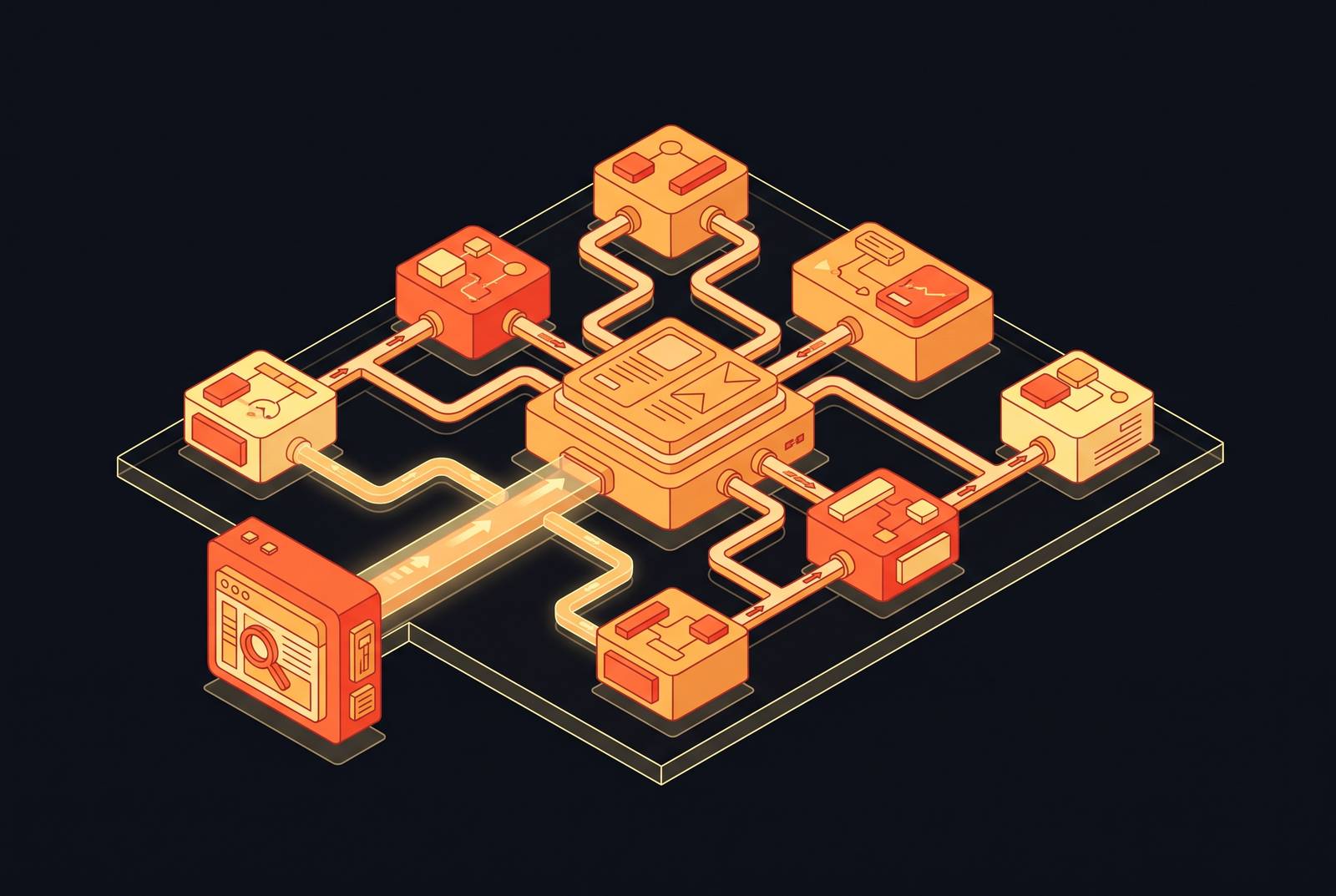
Integrating a Research API into a multi-agent system is an architectural decision. Real-time web grounding improves the system only when retrieval has a defined owner, citations survive hand-offs, and calls fit the workflow’s latency budget.
Why multi-agent systems need real-time web grounding and what breaks without it
Static training data cannot show what current prices, recent filings, breaking news, or live system state are. Multi-agent hand-offs make that limitation harder to detect. Consider an orchestrator that delegates a research task to an agent, which answers from training memory. The response looks plausible, so the orchestrator passes it to another agent for analysis. A stale fact has now become a downstream premise, with no signal that it may be months or years old.
The Agentic Web paper frames this shift as a move from user-centric retrieval to agentic information retrieval, where agents issue queries and evaluate the results. Who establishes that a plausible answer is current? A Research API makes retrieval explicit, time-stamped, and cited, giving the pipeline sources it can inspect.
How the leading orchestration frameworks model tool calls and where a Research API fits in each
LangGraph models workflows as directed graphs, with agents or functions as nodes and conditional edges governed by state. A Research API fits as a tool node. The graph can route to retrieval and then return control to an LLM node, supporting a loop. LangSmith exposes node traversals so teams can audit when and why research was invoked. LangGraph is an independent library built by LangChain that can be used independently of the LangChain framework.
CrewAI models coordination through roles and task results. A Research API fits a role dedicated to research, which sends its output to other agents as a task result. Tool ownership remains explicit in this model. Developers assign tools to roles, configure retrieval-based knowledge sources, and enable planning through planning=True when needed. Developers still need to assign tools when they use configured knowledge or opt-in planning.
Microsoft Agent Framework also supports role-based tool ownership, so a specialized agent can own the research. Its monitoring supplies the relevant operational view. The framework combines capabilities from AutoGen and Semantic Kernel, with OpenTelemetry-based monitoring that exposes Research API latency in traces.
Google ADK organizes agents into hierarchical trees, so the Research API fits at a leaf agent that receives retrieval tasks from a parent orchestrator. Structured results flow back up the hierarchy. Its A2A protocol support also allows research to appear as a callable agent endpoint. A modular runtime and built-in debugging UI support that delegation model.
AWS Agent Squad routes requests across specialized agents, making a capability-described research agent its natural integration surface. The orchestrator selects that agent when the request has research intent. The overlap analysis tool helps prevent selection for irrelevant requests. Native integrations include Bedrock, Lambda, and DynamoDB, while CloudWatch logging is optional when deployed on AWS Lambda.
The role of MCP as the common integration layer and what it changes for tool registration
The Model Context Protocol provides a common registration pattern across MCP-compatible orchestrators, reducing the need for framework-specific adapters. A Research API exposed through an MCP server becomes discoverable and callable by compatible clients. Registration no longer needs a separate integration for every framework. The Agentic Web paper describes MCP as enabling standardized, dynamic access to tools and environments beyond static pretraining data. That standardization concerns access, while workflow routing still belongs to the orchestration design.
During server-client discovery, the tool declares its name, description, input schema, and optional output schema. For a Research API, the recommended input is a query string with optional domain, recency, or source-type filters. The output schema should separate the answer, cited sources with URLs and retrieval timestamps, and a confidence signal. These fields give the hand-off a defined contract.
The natural-language description needs as much care as the schemas because the orchestrator uses it to decide whether the tool fits a task. Could an unclear description lead to calls for work the research agent does not own? The practical recommendation is to describe the tool precisely, scope its MCP server to read-only operations, and declare the data it can access. Read-only access limits what an unexpected call can do.
Agent role specialization: why a dedicated research agent outperforms a generalist that searches when needed
In a pipeline for competitive intelligence, three analyst agents might each need market data. If each can search independently, they can issue redundant queries and return overlapping sources that inflate later prompts. A dedicated research node changes that arrangement. The orchestrator sends it the research intent, and the analysts receive a deduplicated result with shared citations. This avoids uncontrolled query fan-out without requiring every analyst to manage retrieval.
The research agent owns query formulation, including domain filters and recency parameters, then deduplicates overlapping results before packaging them for other agents. Citation packaging includes the URL, title, retrieval timestamp, and excerpt. The orchestrator owns the question. This division makes research reusable across tasks instead of embedding retrieval logic in each analyst.
CrewAI and Microsoft Agent Framework support this separation through role descriptions and tool assignments. In LangGraph, defined node inputs and outputs make it clear what crosses the boundary, while conditional edges control when research runs. A dedicated node therefore need not fire speculatively just because the tool is available.
Context passing between agents: how to carry citations without inflating the context window
Passing several sources’ full, multi-paragraph excerpts into the next agent’s prompt inflates its context window and dilutes the answer-relevant signal. A free-text summary presents the opposite risk if it loses the connection between claims and sources. The useful distinction is between evidence available to the pipeline and evidence loaded into a particular prompt. Those need not be the same payload.
The recommended hand-off is a compact, structured object containing a bounded answer synthesis, source references, the exact query, and a confidence indicator. Each source reference includes its URL, title, domain, publication date, retrieval timestamp, and a one-sentence excerpt. The research agent’s system prompt should set a cap on the number of tokens in the synthesis. Downstream agents receive that synthesis and request specific sources on demand.
LangGraph maps this pattern to shared state. The research node writes the structured output, subsequent nodes read only the fields they need, and the full source list remains available for inspection. CrewAI passes task results, so its research output should use Pydantic or a similar typed schema in place of free text.
Pipelines that run for a long time also need session-level caching keyed by query so similar requests do not trigger repeat calls or add the same context again. The query echo serves a different purpose. It lets a downstream agent modify the original search if the answer is insufficient, while a structured confidence flag or numeric score gives the orchestrator a basis for human-review routing. What should move forward is not just an answer, but enough structure to challenge it.
Latency budgets: when a synchronous Research API call is acceptable and when it becomes the bottleneck
A research call becomes a bottleneck when the workflow must wait for it on the critical path. Sometimes that wait is the correct design. A financial analysis agent that must cite live data before it writes a report should block until the evidence arrives. Choose whether to block on research based on whether useful work can proceed without the result.
When research tasks are independent, parallel execution avoids making them wait for one another. A pipeline that needs market data, regulatory context, and competitor news can send those queries together and merge the results before synthesis. LangGraph supports this through parallel node execution.
Speculative pre-fetch suits a different condition, where the orchestrator can predict with high confidence that research will be needed. A query classifier routing into a research-heavy workflow can initiate retrieval before the downstream agent finishes initializing. The latency budget should still belong to the role. Research that gathers intelligence in the background can take longer than research within a user-facing assistant turn.
A timeout policy defines what happens when that budget expires. Recommended options include a recent cached result from an equivalent query, an output explicitly flagged as ungrounded and routed to human review, or a narrower query that can complete faster. These fallbacks involve different compromises. The architecture must show which fallback it used and make clear when output lacks research to ground it.
Evaluating Research APIs for production use: accuracy benchmarks, output structure, and security certifications
Production procurement should evaluate benchmark accuracy, cost predictability, latency profile, structured output control, and security certifications. The choice of benchmark can change which provider looks strongest, because general web question answering and domain-specific research test different skills. The recommended dataset should therefore match the agent’s actual queries, with finance-domain tests weighted for financial workflows and broader sets used for general knowledge tasks.
You.com self-reports a leading Research API score on DeepSearchQA, although it does not currently hold the top position on independent leaderboards. Its vendor-run FinSearchComp comparison ranks the Finance Research API first on the T2 historical lookup sub-task. The scope of each claim is essential. These public results offer evidence to examine, but neither a vendor-run comparison nor one sub-task establishes performance across an entire production workload.
Output structure determines how much repair the consuming agent must do. Free-text responses need another step for parsing and restructuring, which adds another place where things can fail. The recommendation is to look for schema-consistent outputs with cited sources as structured objects, machine-readable confidence fields, and answer text separate from metadata. Latency then needs to be checked against the role and execution pattern it will serve, since a speed claim on its own leaves out that context.
Security review must account for what research queries disclose, including customer names, internal strategy questions, or financial positions. Zero-data-retention means the provider does not use those queries as training data or keep them as logged records, so a review of security certifications needs to check the retention policy too. Cost needs equally concrete controls. Parallel research can turn one user workflow into many calls, so per-call pricing without a volume cap can create unbounded spikes. Usage dashboards, rate limits, and cost controls that connect to orchestration observability are therefore part of the procurement criteria.
Governance and observability: making a research-grounded pipeline auditable in production
Production readiness requires a trace from each research call to the decisions it influenced. Logging that a tool ran is insufficient. The observability layer must capture the formulated query rather than only the original user intent, returned sources with retrieval timestamps, the downstream recipient and its decision, and the confidence signal with any human-review routing. That record connects retrieval to consequence.
LangGraph checkpoints save state after each super-step, providing a basis for inspecting the research-to-decision chain. Durable use requires a durable checkpointer backend. Replay also re-executes nodes rather than merely reading a static log, which is an important distinction when retrieval can change. Microsoft Agent Framework’s OpenTelemetry monitoring exposes agent run latency, model call latency, and tool invocation counts as standard spans, supporting alerts when research repeatedly delays execution.
The Agentic Web paper names context injection at the protocol level and privilege escalation through chained tool access as ways that attackers can exploit agents that act on their own. Traces are also a detection surface. Unexpected domains, unusual query volumes, or sensitive context in research queries can expose anomalous behavior for review.
Real-time retrieval also makes outputs non-deterministic because the same query at different times may return different sources. Retrieval timestamps and source lists make that variation explainable by recording what information was available to the agent. For regulated workflows, the cited response supplies an evidentiary basis for compliance review without a separate collection step. That traceable output is a deployment asset. It gives reviewers a record they can use to judge whether to trust a high-stakes decision.