Rate Limit Handling and Retry Logic for Search APIs in Production
How to keep search pipelines alive when rate limits hit hard in production.

Production search API rate-limit handling is a coordination problem. Keeping agentic pipelines alive under real traffic requires header-aware backoff, jitter, proactive throttling, request queuing, and circuit breakers working together. The goal is graceful degradation, so quota pressure slows work or defers it rather than causing dropped results, corrupted context, and cascading failure.
Why rate limits hit differently in agentic search pipelines than in ordinary API integrations
A single-caller integration can often treat a rejected request as an isolated event. An agentic pipeline may fan out concurrent search calls across workers, then use the results in later reasoning. A single unhandled 429 can therefore propagate into incomplete context, silent data loss, and runaway costs.
Two distinct forms of coordination failure compound the problem. Concurrent agent threads can hit a limit together and retry on the same schedule, turning a transient rejection into a sustained stampede. Scheduled jobs, manually triggered runs, and background enrichment can also use the same quota without shared state. Each worker believes it has headroom that the others have already consumed.
Search APIs can enforce both requests per minute, or RPM, and tokens per minute, or TPM. OpenAI’s rate limits documentation describes organization-level and project-level limits across RPM, RPD, TPM, TPD, and other dimensions. For a pipeline facing layered quotas, room in one budget does not imply permission to proceed in another.
Reading what the API is already telling you — rate limit headers and error codes
The HTTP response is the first input to a sound control strategy. A client should parse available rate-limit headers on every response because successful calls can reveal approaching exhaustion. Why wait for rejection when remaining capacity is already visible? That information lets the client distinguish an approaching limit from one it has already crossed.
Retry-After specifies either a delay in seconds or an HTTP-date before the next attempt. It establishes a minimum wait. X-RateLimit-Limit gives the allowance for the window, while X-RateLimit-Remaining reports the requests left. X-RateLimit-Reset identifies when capacity resets, although implementations can express it as a timestamp or seconds remaining. The parser must respect the provider’s convention.
Header names are not uniform across providers. Cloudflare adopted the IETF draft format in September 2025, while GitHub continues to use vendor-prefixed X-RateLimit-* headers. Stripe uses Stripe-Rate-Limited-Reason. Some search providers publish only Retry-After on 429 responses, and others publish no rate-limit headers, so missing metadata requires a fallback.
Status codes determine which response is appropriate. A 429 with Retry-After calls for the specified wait followed by jitter, whereas a 429 without it calls for exponential backoff. A 403 should not be retried, because it often signals tier-level quota exhaustion. Treating these outcomes alike wastes requests and can put the key at risk.
Exponential backoff with jitter — why the algorithm matters and how to implement it correctly
Immediate retries return to the same exhausted quota. Fixed-delay retries merely postpone the collision when concurrent callers all choose the same delay. Exponential backoff spaces successive attempts farther apart, but without random variation it still preserves synchronization among callers that failed together. Jitter breaks that shared schedule into scattered attempts.
The retry path must first classify the error. Code that retries every exception cannot distinguish a 400 bad request from a 429, so it may repeat a request that cannot succeed. Even when failed attempts consume no provider tokens, they still use round trips, throughput budget, and system time. Ten independent callers repeating that behavior make recovery harder for one another.
A correct implementation makes its branches explicit. On a 429 with Retry-After, it parses the value, waits at least that long, and adds jitter without lowering the provider’s floor. Without that header, it uses full jitter over an exponentially growing delay range, starting with a short initial delay and doubling the range on each attempt.
Retries also need a firm stopping point. After a defined maximum, such as four attempts, the client stops retrying inline and hands off the job. Both RPM and TPM remain potential reasons for rejection throughout this process. An available request budget cannot make a retry succeed while the token budget remains exhausted.
Proactive throttling with sliding window rate accounting on the client side
Backoff answers what happens after a request is rejected. Proactive throttling asks whether it should be sent yet. By tracking how much quota it has used before it sends a request, a client can skip many round trips that would fail and leave headroom for high-priority work. The tracking model should reflect the provider’s likely behavior rather than assume that every quota resets in the same way.
The canonical algorithms make different trade-offs. Fixed Window Counter is inexpensive but permits boundary bursts of roughly twice the stated limit. Sliding Window Log is exact but needs O(n) memory per client, while Sliding Window Counter uses elapsed-time weighting to blend the counts from the current and previous windows and get a nearly exact count with O(1) memory. Token Bucket permits controlled bursts while enforcing a long-term average, whereas Leaky Bucket imposes a constant output rate.
For general public APIs, a sliding window counter is the recommended client-side default. The client should maintain counters for both RPM and TPM and begin throttling as consumption approaches quota. In multi-tenant or multi-environment deployments, the client should keep a separate count for each API key. Otherwise, one noisy consumer can suppress capacity available to others.
Across workers sharing a key, however, that accounting must be shared. Independent local counters cannot describe their combined consumption. Redis server-side Lua scripts executed through EVAL can update shared state atomically in a single round trip, avoiding the time-of-check/time-of-use races that WATCH/MULTI/EXEC retry loops address.
Request queuing for non-interactive work — decoupling the caller from the rate-limit surface
Not every search request needs an inline answer. Background content enrichment, scheduled research, monitoring jobs, batch lead enrichment, and competitive intelligence sweeps can run outside a user-facing response path. Agentic fan-out also belongs in this category when individual search results are assembled asynchronously.
Requests enter a durable queue, and a rate-controlled worker drains it at a pace calibrated to quota. The caller receives an immediate acknowledgment. That acknowledgment separates acceptance of work from the time required to finish it.
The worker then owns the backoff logic. If a request receives a 429, the worker pauses its drain rate and waits while the queue absorbs incoming work.
A queue alone does not coordinate consumption, however. Three workers draining it independently can collide if each assumes that the full quota is available. Centralized quota state is what makes their combined drain rate controllable. Queuing with shared accounting solves the multi-worker collision that reactive retry cannot, but sustained failures despite that coordination call for a broader stop mechanism.
Circuit breakers — detecting when retry and queuing are not enough
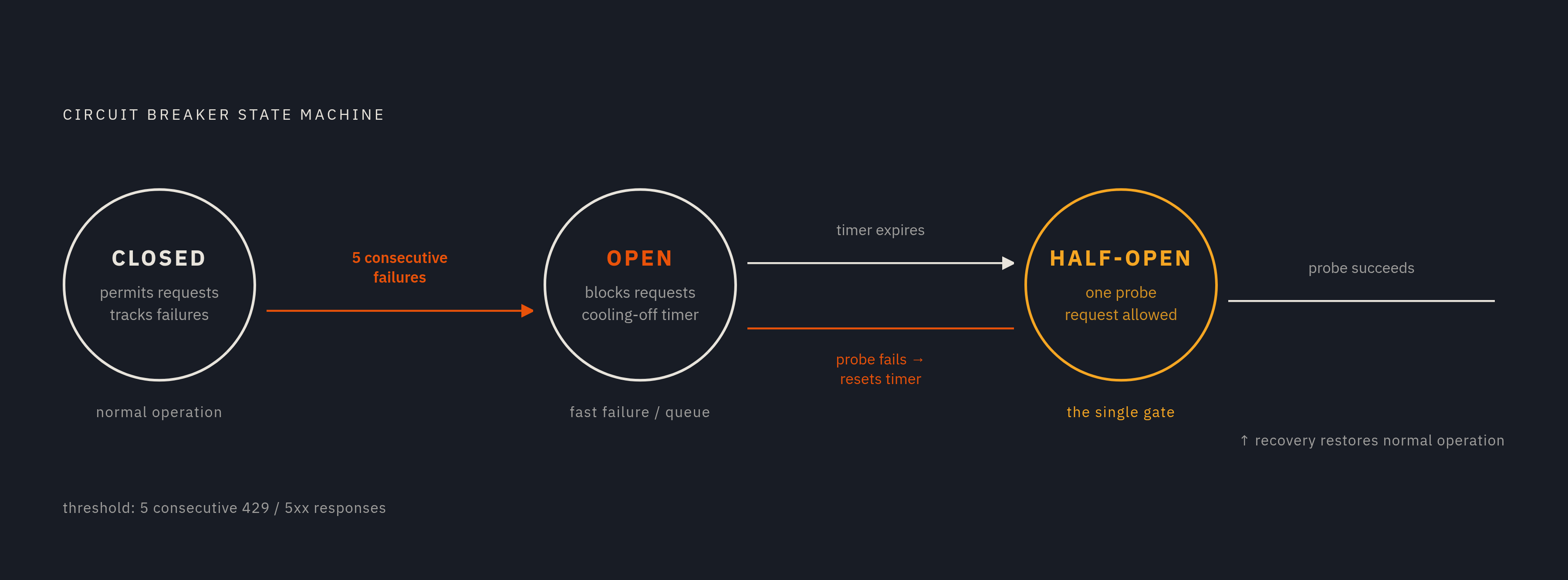
Consecutive failures despite correct backoff and controlled queue draining suggest more than a transient collision. Continuing to send requests can spread that pressure to every caller. A circuit breaker detects this condition and temporarily stops attempts against the API.
The state machine has three states: closed, open, and half-open. While closed, it permits requests and tracks consecutive failures against a threshold, such as five consecutive 429s or 5xx responses. When the threshold is reached, it opens and sends new work to the queue or returns a fast failure. After a defined cooling-off period, it becomes half-open and allows one probe. Success closes the circuit, while failure restarts the cooling-off period.
The queue and breaker serve different purposes. The breaker suspends attempts, while the queue preserves deferred work until the circuit closes and draining resumes. Without that distinction, a retry path could continue applying pressure precisely when the system has decided to stop.
Repeated or prolonged openings also provide diagnostic evidence. They can signal tier-level quota exhaustion, a misconfigured concurrency limit, or overlapping scheduled jobs. A late run followed by a manually triggered run, for example, can keep demand high even when delays are changed. The breaker exposes that mismatch instead of allowing it to appear as scattered, intermittent failures.
Composing the full resilience layer — how the patterns interact under real agentic traffic
Consider an agentic research pipeline fanning out 20 concurrent search calls while quota is tight. Calls first need to be distinguished by whether they require an immediate response or can be assembled asynchronously. Work that can wait goes into the durable queue, while latency-sensitive work stays on the inline path. Both paths use shared quota accounting before dispatch, so separate workers do not each claim the same headroom.
Proactive throttling then slows requests that would approach the available RPM or TPM limit. It prevents avoidable rejection but cannot guarantee that every admitted call succeeds. An unexpected burst can still exhaust capacity. For any resulting 429, header-aware backoff respects the provider’s wait instruction or falls back to exponential backoff with full jitter.
On the queued path, the worker handles that wait. On the inline path, the attempt cap prevents retrying indefinitely and provides a point for handing off work. If failures in a row reach the breaker threshold, both paths stop making calls to the API. Work that can wait stays queued until a half-open probe succeeds and normal operation can resume.
Each layer covers a gap in the others. Backoff cannot coordinate independent quota consumers, and queuing cannot replace the inline path for latency-sensitive calls. A breaker detects sustained failure after initial rejections have occurred. Proactive accounting reduces those rejections but cannot recover from unexpected exhaustion on its own. Their composition allows the pipeline to slow, defer work, and recover without dropping results into an incomplete agent context.
Provider behavior still affects the implementation burden. Complete rate-limit headers give the client explicit guidance, whereas absent headers leave it dependent on its own accounting and fallback delays. A well-composed layer makes provider choice less disruptive operationally, but it does not erase differences in latency and uptime. When the service runs well, the retry and circuit-breaker paths rarely need to run.
What to monitor so the resilience layer stays calibrated over time
Quota tiers, traffic patterns, and the way jobs are scheduled change over time. A threshold suited to one workload can become too sensitive or too permissive for another. Along with whether requests succeed, monitoring should ask whether they need more retries, longer queues, or more pauses to do so. Those trends show that the resilience layer has less room to cope.
Five dashboard measures make that question concrete. Rate-limit hit rate shows whether proactive thresholds or queue drain rates need recalibration. Retry success rate reveals whether rejected requests eventually recover, with a low rate suggesting an overly permissive breaker threshold or insufficient quota. Queue depth over time exposes work that accumulates without draining. Circuit-open frequency and duration distinguish occasional brief interruptions from structural mismatch, while TPM consumption tracked with RPM reveals token exhaustion that request counts miss.
Alerts should track rate-limit hit rate and circuit-open events as well as HTTP errors. By the time errors rise, the resilience layer is already under stress. Provider-health monitoring also addresses changes that retry logic cannot repair, including deprecations, tier restructuring, and quota policy changes.